

The Dots-based games described in the previous article, which emerged at the turn of the millennium, were interesting in their own right, but like many pioneers, they remained in the shadow of the first truly successful project. This was Points XT, the pinnacle of computer-based gaming clients. It was actively used for many years, became a benchmark in gaming and social functionality, and made an invaluable contribution to the standardization of game rules. The project engendered the first sustainable community of players, who, over several years of regular play, raised their average skill level to a previously unheard-of level, laying the foundations for tactics and strategy, and clearly demonstrating the enormous combinatorial potential of Dots-based games. Some members of that constellation continue to play to this day, and the statistics of Points XT's leading star, Vladimir Borodin, aka SUPERZmei, can, with some degree of conventionality, be considered unrivaled.
It's all the more surprising that it's currently virtually impossible to provide detailed information about the program's creation and the project's early years. Objective information is scarce, and those who were at its origins, with rare exceptions, either ignore attempts to communicate or respond extremely sparingly, as if fearing some kind of confidentiality breach.
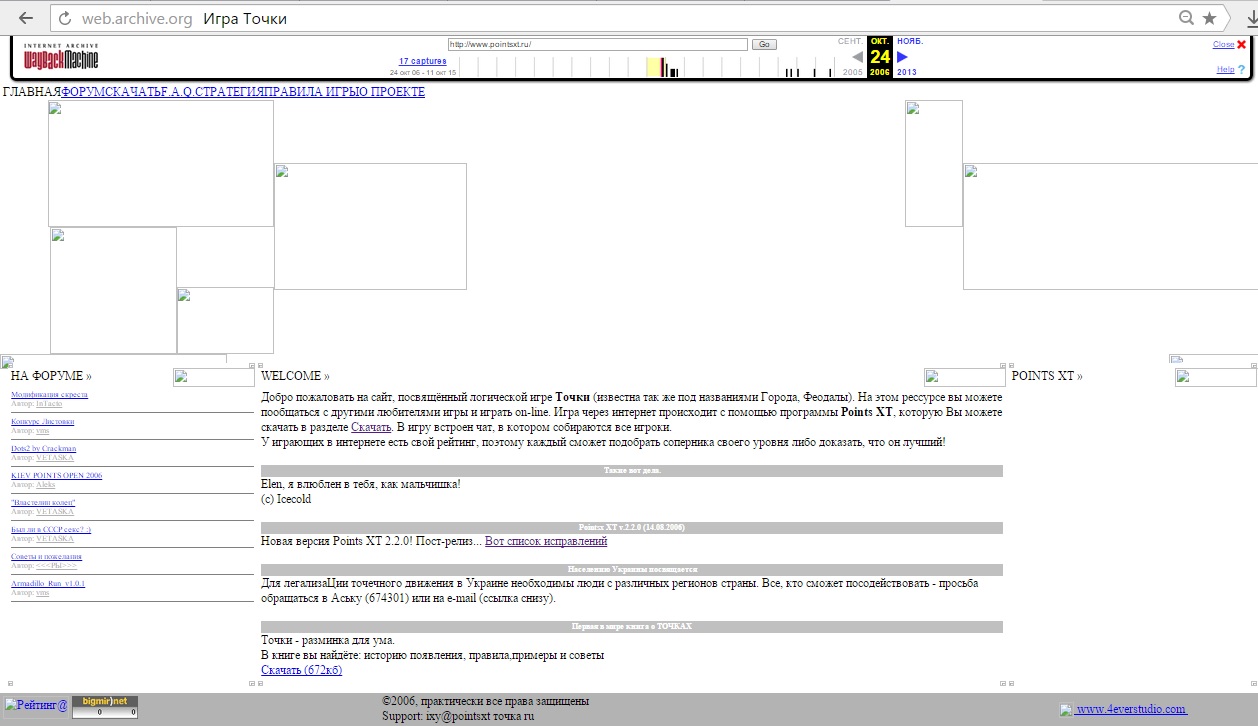
The client itself, version 2.2.0, is still available. However, since its inception, the project has moved across several servers and portals, maintained by different people. Continuity is a stretch. The client's program information contains information about the most recent team, but nothing more. The only remaining vestige of the past is the creator's nickname, iXy,which the client's bot still responds to. However, problems are starting to arise with the real name. Both the client itself and the portal to which it is currently assigned claim that the author of "Points XT" is named Yaroslav Azarov. This person does indeed exist on one of the social networks, and there is every reason to believe that this is the same iXy, but the last name "Azarov" appears to be fictitious. He ignored all attempts to communicate, but back in 2006, Vitaly Kolosov, aka VETASKA,who was directly involved in the project's development (which will be discussed separately), published a book, "Dots: A Warm-Up for the Mind",in which Yaroslav Volkovis credited as the program's creator. Vladimir Borodin, mentioned above, shares this opinion. The connection between Volkov and "Azarov" is quite clear: "Azarov," actively using the nickname iXy, promotes a website dedicated to computer games, a link to which, with the explanation "a project by the author of the Points XT client," is available on a portal owned by Kolosov himself. "Azarov's" hometown, Barnaul, is also apparently part of this peculiar legend. The real Volkov lived in Kerch in the mid-2000s, as confirmed by the user page of iXy, one of the administrators of the project's now-defunct forum (data saved in the web archive). There is also no precise information about the time of the program's creation. Kolosov claims in his book that it was 2004, without specifying the exact month or date. Borodin generally agrees with this dating. The oldest games for which we have files date back to July 2005. However, Sergei Efimov, aka SeregaMF —another player who experienced Points XT in its early days—reports having the following file: "SeregaMF vs Xtar-01 11.01.05 18-33.sav." This means that this game was played on January 11, 2005. The project's first portal, according to web archive data, appeared online no later than October 24, 2006.
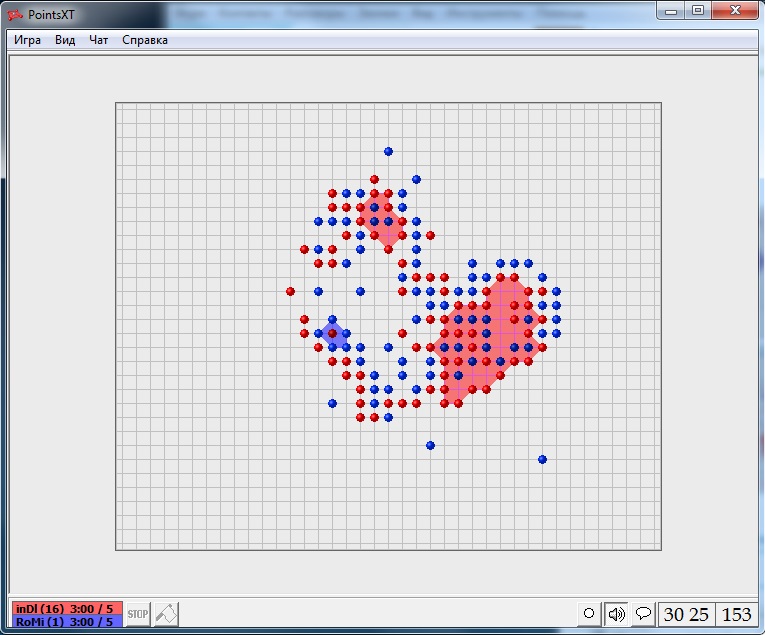
As noted above, the Points XT client is a program that must be downloaded and installed on your computer. It allowed you to play against yourself or with other players via a remote server using the IRC protocol. It was the first truly multiplayer client, which also allowed for normal communication via public and private chats. Of course, at first, it didn't support all the functionality available in the latest version, and it also looked different, but it's impossible to trace the development stages based on the information available online.
Points XT boasts unrivaled reliability and stability, a sleek, "black" design, and a simple and user-friendly interface with a fairly comprehensive set of settings. The game's rules, which, according to Borodin, were initially formulated by Volkov and then refined through interaction with players, have become the benchmark for post-Soviet computerized Dots games: a strictly minimal trajectory, houses in which dots can be placed, no extra moves, a board size of 39 by 32 squares (the size of a standard notebook sheet), an initial cross, or, if it's absent, a limited area for the first dots, the ability to end the game early by landing, and a time limit per move. A blitz mode was subsequently devised and implemented: 5 seconds per move and automatic placement of a dot in a random location when the time expires.
Online players were displayed in a single list, the game start order was intuitive, and it was possible to set a "busy" status. The program allowed not only playing but also watching other players' games as a spectator. A function was implemented for saving games as files for later viewing in the client. General chat and private correspondence logs were also saved, allowing the client to be used as a full-fledged communication tool. The appearance of the playing field—lines, dots, and encirclement regions—gradually took on forms that are now taken for granted (the only anachronism, a nod to "paper" dots, is the option to color not only full-fledged regions but also the adjacent spaces between adjacent dots). The color of the lines and background could be adjusted using a palette, and the dots could be selected from several fixed options. Sound accompaniment was added for various processes, such as placing a dot, receiving a private message, or attracting the attention of a player. There were settings for the field scale, display of the program window, chat, language, as well as a fairly extensive and well-written instruction manual.

Yes, many of the game rules and client features listed above weren't entirely new, as they had been used in earlier projects in one way or another. However, it was Volkov who first combined them into a single system, bringing the work of his predecessors to its logical conclusion. Some solutions, however, can be considered revolutionary without any reservations.
The game time system was unique and unused anywhere else. In non-blitz games, three minutes were allowed for every five moves. However, losing on time was impossible, since after three minutes, a dot was automatically placed at a random location on the board, and the move passed to the opponent. This rule, however, interfered with another unique feature that allowed a move to be cancelled within two and a half seconds of placing a dot. Specifically, three times per game, a dot placed automatically after the allotted five moves had elapsed could be cancelled by pressing the "undo move" button. These rules, along with the large board size, made games between roughly equal opponents very lengthy. Furthermore, the game-saving feature allowed the player to interrupt the game at any time and resume it later.
 Points XT was the first project in the East to implement a fully functional rating system, a slightly modified version of ELO. For example, during the first five games, any new player accruing rating points didn't take them away from losing opponents, and a draw didn't change a player's rating. After this system was introduced, the ability to choose between ranked and unranked games was added to the client settings. Using certain service commands, one could always view one's own or another player's statistics, as well as display a list of the top players by rating. It's worth noting that Points XT eliminated the problem of so-called clones—additional characters of the same player. Since the program was installed on a computer, all nicknames created by the user were linked to a specific system and displayed in the statistics as a full list. This meant that a second computer was required to create a full clone. Once a rating was achieved, it would not change over time, but if there were no ranked games for a month, the player would no longer appear in the top list.
The project's first server was irc.kerch.net.Its exact statistics are unknown, so we'll have to limit ourselves to the approximate figures Kolosov cites in his book. According to him, the total number of visitors over the first two years was 6,000, with at least a thousand users playing at least one game. Of course, these are paltry figures by today's standards, but compared to its predecessors, the audience reach has grown exponentially. Specific efforts to increase traffic were undertaken by both the program's creator and some players. As noted above, a project website appeared in 2006, where users could download the client and participate in the forum. Furthermore, Go players were invited to Points XT, as were Poles, who by then had long-established resources dedicated to Dots. Borodin, for example, was actively pursuing this, seeking serious opponents who could provide competition. According to him, such measures allowed for the one-time online number to increase from the initial 3-5 to 10 or more players.
Despite its technical sophistication and a more significant social component, Points XT, like its predecessors, was a purely amateur endeavor fueled by sheer enthusiasm. For two or three years, as long as the creator's will and the novelty lasted, it thrived. A group of passionate players formed, assisting Volkov in refining the game's functionality, developing rules, and promoting it. By constantly playing against each other, they significantly improved their average skill level, and a measured influx of newcomers allowed them to quickly learn the basics, further increasing competition. The project quickly became something of an elite club with its own atmosphere, distinctive playing style, and etiquette. Players who graduated from the Points XT school typically displayed a certain romanticism, a dislike of defensive play, and tried not to exploit random mistakes by opponents or technical glitches to achieve victory. Borodin remained the undisputed authority, but other leaders were also outstanding masters of their time. There were no frankly weak players at Points XT.
 This period also saw the first attempts to develop and systematize the theory of the game of points. For example, individual theoretical articles were published on the project forum by Vladimir Shchelokov, aka vms, and Anton Morzhakov, aka morjik.The latter's article on blitz, written on January 19, 2007, can still be read today. The most thorough attempt to bring together the history, theory, and practice of Dots was Kolosov's aforementioned book, "Dots: A Warm-Up for the Mind", published under the auspices of the Ukrainian public organization "Country of Intelligence" and first published in 2006. Kolosov, one of the moderators of the irc.kerch.net channel, worked on the Points XT project from the very first years, was a very strong Dots player himself, and his personal ambition and entrepreneurship allowed him to subsequently become the most prominent figure in the Dots community. At the time of publication, his book was a landmark event and certainly contributed to the development and popularization of Dots. Several chapters on the rules of the game, specific tactical and strategic techniques, and a collection of practical problems are still relevant and can be recommended for beginners. The only misstep seems to be the deliberate exploitation of East Asian motifs with constant appeals to the affinity between Dots and Go. The attempt to capitalize on the popularity of an ancient game is understandable, but the harm from such "advertisement" is perhaps greater than the immediate benefit, since the reader inevitably concludes that Dots are secondary when framed this way. Moreover, the author reduces the history of the game to a distortion of the rules of Go, omitting everything that occurred before the advent of Volkov's program.
The first attempts to give the Dots community some official status were also associated with Points XT. The project's website featured the following announcement for a long time (original spelling preserved): "To legalize the Dots movement in Ukraine, people from various regions of the country are needed. Anyone who can assist is requested to contact us via ICQ... or email".This also includes the aforementioned public organization "Country of Intelligence," information about which online is limited to a brief mention on Kolosov's website. Unfortunately, these initiatives never developed further.
The year 2006 also marks the beginning of the tournament history of Dots - this important and extensive topic will be devoted to a separate study.

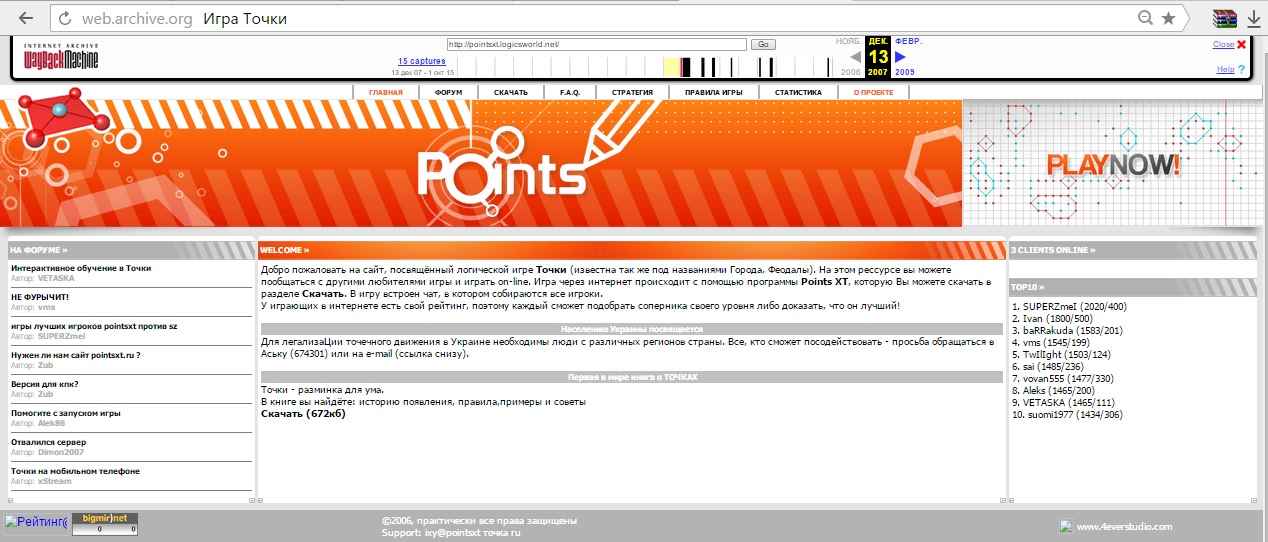
The final update to the Points XT client, version 2.2.0, was released on August 14, 2006. This marked the peak of the project's development and the beginning of its decline, which became evident a year later. The program's creator had become too important to the small community of enthusiasts, and problems began with Volkov's retirement. One eyewitness, Pavel Milov, aka sai, described the process on his website (now also defunct): "The iconic Points XT program, which for a long time was the most advanced Dots project and united the strongest players, is now forced to exist in a 'more or less poor' state." The decline began with the loss of interest in the project by its founder, iXy. In the fall of 2007, the oldest Dots server, irc.kerch.net, went down, and soon afterward, the pointsxt.ru domain was lost. To replace the game server, the World of Logics team launched the IRC server logicsworld.net (currently rarely visited), and the Points XT website and forum content was moved to pointsxt.logicsworld.net.In 2008, another branch of Points XT development emerged. One of the moderators of the irc.kerch.net channel, known by the nickname VETASKA, created his own channel for the game within the tochki.org project— irc.tochki.org.After some time, the old statistics bot and ratings were restored. However, restoring the former infrastructure did little to improve the dire situation—while the Points XT program is still accessible, it is clearly technically outdated and is not being developed. The migration of players from server to server, in turn, hit the project in another way. The Points XT player community became fragmented, and many of them, deprived of their familiar social environment, lost interest in the game itself.
Indeed, the last copy of the pointsxt.ru website saved in the web archive is dated August 10, 2007. The first copy of the new website appeared on December 13, 2007. It lasted for quite a long time: the last copy was saved on October 25, 2012. However, traffic was apparently minimal during this time, and the last forum posts date back to 2009.
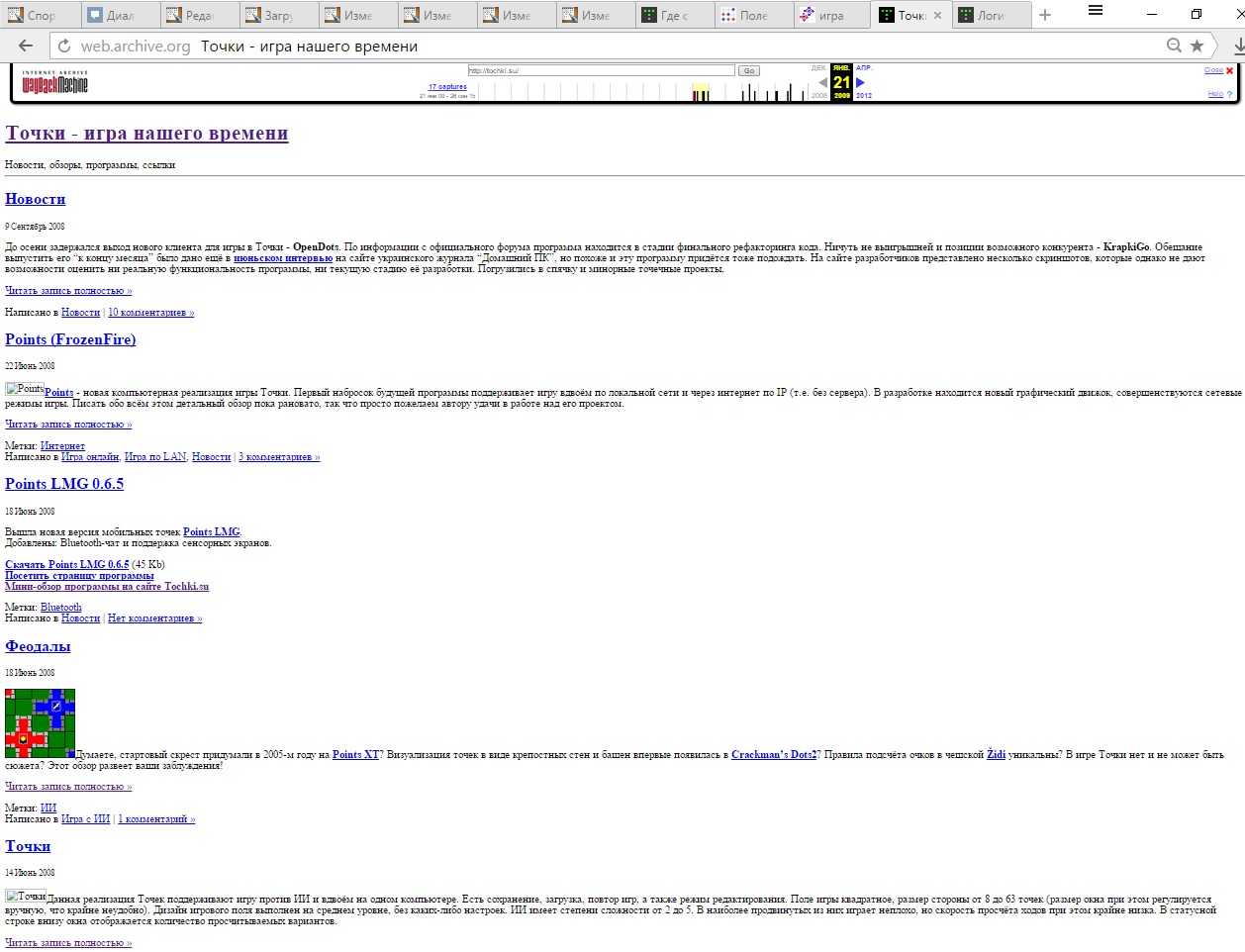
The fragmentation of the community, however, began even earlier. On June 11, 2007, the first copy of the website created by Kolosov (now defunct) appeared. Over time, it acquired a forum, a personal blog by the owner, various thematic materials, tournament information, and much more. For several years, the site held a leading position among the resources dedicated to the topic, with Kolosov being the first to attempt to move away from a purely amateur format and convert interest in the sites into real money through advertising. Enthusiasm was all well and good, but maintaining a gaming channel and portal, as well as hosting offline tournaments, required considerable investment. Milov tried to compete for a while, and it must be said that his site, tochki.su,created in early 2008, was distinguished by its high-quality content—articles and reviews. However, it was rarely updated, couldn't boast high traffic, and was sustained solely by the author's enthusiasm, which lasted until mid-2012.
Milov was also a co-author of an ambitious, but never realized, project: the OpenDotsgaming client. Its creators, the aforementioned World of Logics team, envisioned it as a worthy replacement for Points XT and a way to unite the fractious community. Judging by the website's pages preserved in the web archive, work on the client, which began in 2008, progressed extremely slowly and was abandoned that same year.
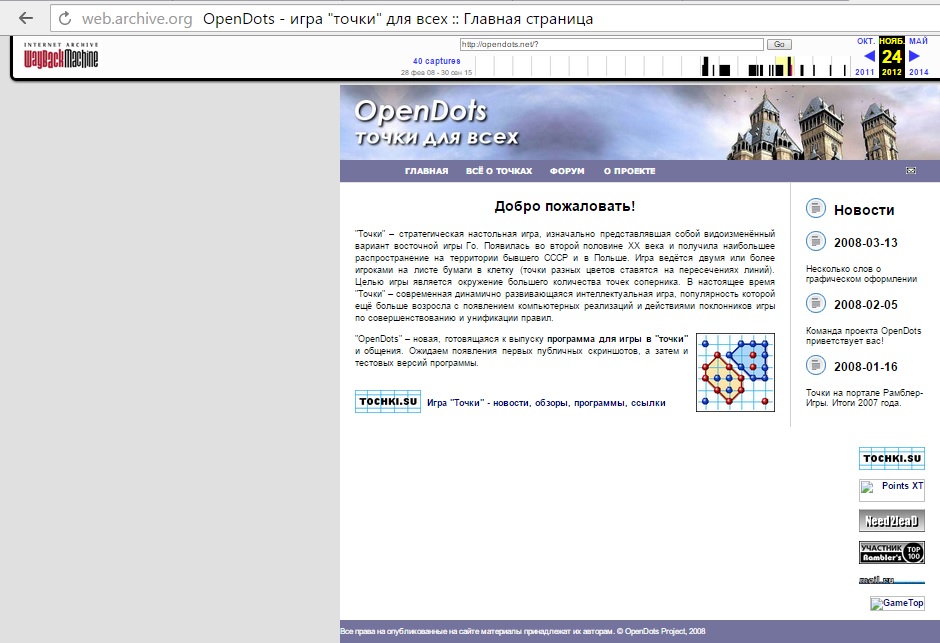
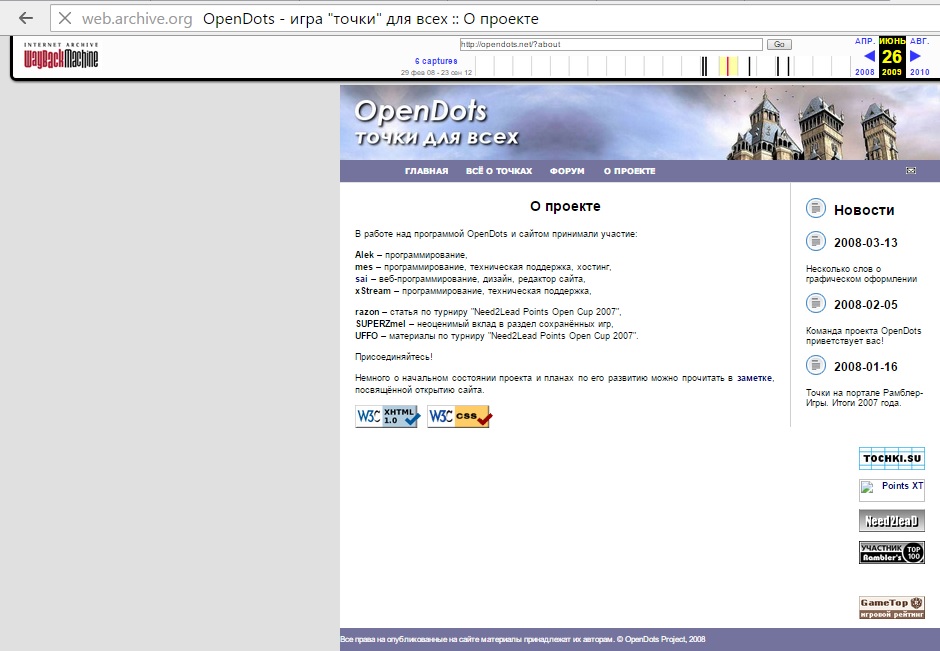
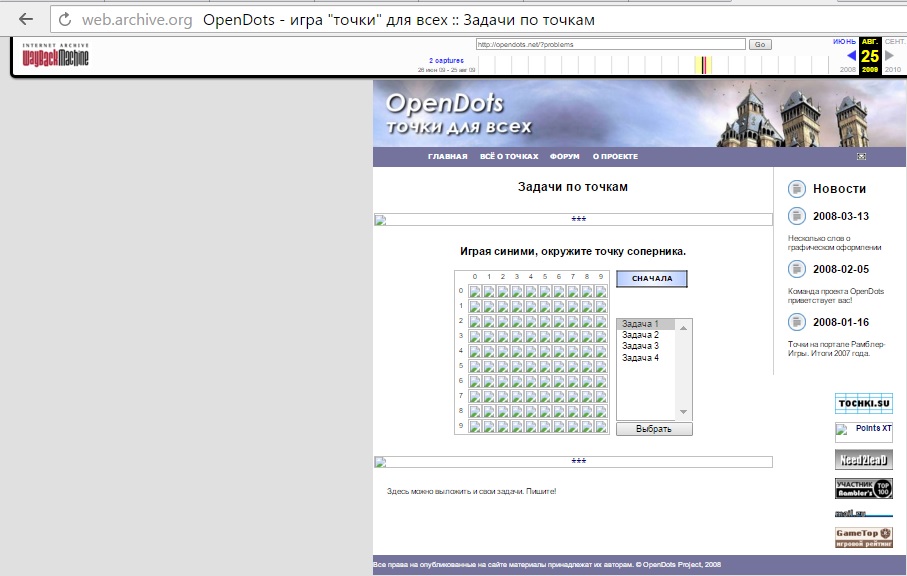
In this case, the adage that you can't step into the same water twice was vividly confirmed. The hopes of the Points XT alumni, who co-authored OpenDots, to replicate the success of the iconic Dots project by simply modernizing the client and appealing to the good old days failed to stand the test of reality. The concept, revolutionary at the beginning of the decade, had clearly exhausted itself by its end, so a qualitative leap required fundamentally different software and social technologies. We will see similar examples in the future—mistakes, unfortunately, tend to be repeated.
Meanwhile, Points XT continued to thrive. After moving the ratings and statistics to irc.tochki.org, a small but close-knit community of players re-emerged there, including some veterans and representatives of the new generation. Capitalizing on the client's former reputation, Kolosov actively promoted his portal as the official and undisputed platform, regularly hosting in-person and online tournaments, attempting to consolidate the Dots community around a single hub and attract the attention of sponsors and advertisers.
 Over time, as other projects emerged, including much more popular ones, Points XT evolved into a sort of order of Dots crusaders. Regulars regularly raided other platforms, testing the natives' playing skills and propagating the true "faith." SUPERZmei, who by then had practically retired from playing and become a living legend, was typically used as a banner. Players from other projects, meanwhile, couldn't be considered fully established until they proved their worth on Points XT. Almost all current leaders, with the exception of the youngest, have followed this path. This initiation did indeed make sense, as the average skill level of the "crusaders" remained quite high, and all tournament activity, essential for competitive growth, was long centered on Kolosov. This symbiosis of quantity, provided by other projects, and quality, maintained at "Points XT," produced good results and seemed to be the most promising path for the development of Dots.
Reality, however, brought its own harsh adjustments. The most widespread Dots project at the time, which we'll discuss in the next chapter, tragically crashed mid-air. The flow of newcomers dried up, causing Points XT to quickly degenerate into a closed social club for old acquaintances. Gaming activity dwindled to nothing, spurring only for a few tournaments. The apparent lack of prospects meant that paying for the game server, as well as maintaining the sports and social components, became burdensome for Kolosov. For a while, he attempted to share expenses with the players, but, finding no understanding, he shut down the server on December 15, 2010. The portal's forum then went down as well. The last in-person tournament in Kyiv took place in the spring of 2010.

However, even Kolosov's retirement didn't lead to the final demise of the remarkably resilient project. A group of players took up the baton, informally led by Vasily Novikov, aka vn91, —a Dots enthusiast and part-time programmer who made a significant contribution to the game's development. For a time, the client was hosted on the ircworld.ruchannel, but in June 2011, it was moved to the newly created pointsgame.netchannel. On June 17, 2011, a new portalopened, which to this day remains the home of the long-suffering but legendary Points XT" The client has virtually lost its gaming and social significance, but continues to be preserved as a relic, occasionally hosting tournaments, for which it remains quite suitable due to its unparalleled reliability. Moreover, in 2011, it received an additional feature – a game with artificial intelligence created based on the algorithms of Evgeny Kurnevsky, aka keij, and Ivan Kochurkin, aka KvanTTT.
So what did Points XT contribute to the Dots? What conclusion can be drawn from its interim history? Beyond the obvious merits briefly described at the beginning of the chapter, there is something far more significant. The project clearly demonstrated the absurdity of the stereotype that Dots have no sporting value and are only suitable for entertaining bored schoolchildren. It was Points XT that first demonstrated that the folkloric image of a school champion bears no resemblance to the true pinnacle of Dots mastery. It was "Points XT" that instilled in dozens and hundreds of people the confidence that their favorite game was not an ugly duckling among intellectual combatants, but fully deserved its place in the sun. It was the memories of this legendary project that kept a handful of enthusiasts from giving up at those moments when the Dots movement's demise seemed absolutely inevitable. For this alone, Points XT deserves eternal life. It must be preserved as a symbol, as a banner, as a priceless tradition. Our young game has too few traditions to allow one of them to sink into oblivion.
Well, as an epilogue to this chapter, I would like to say a few words about two rather curious projects that were clearly late in coming to light.
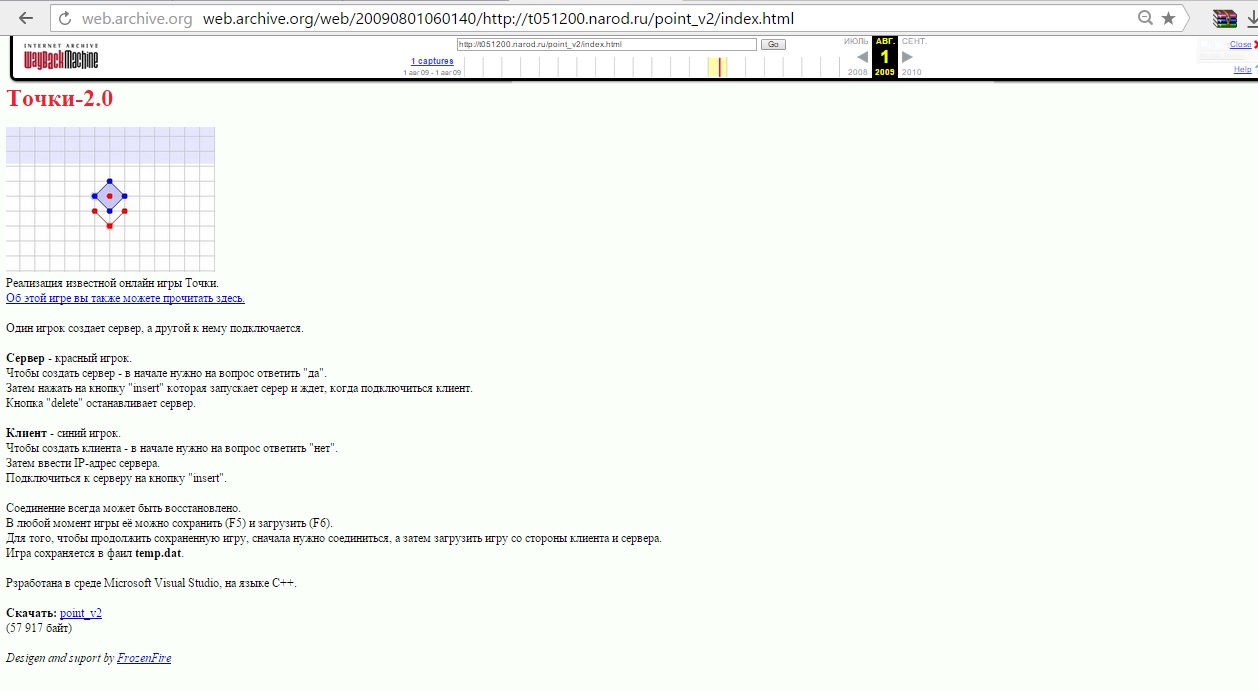
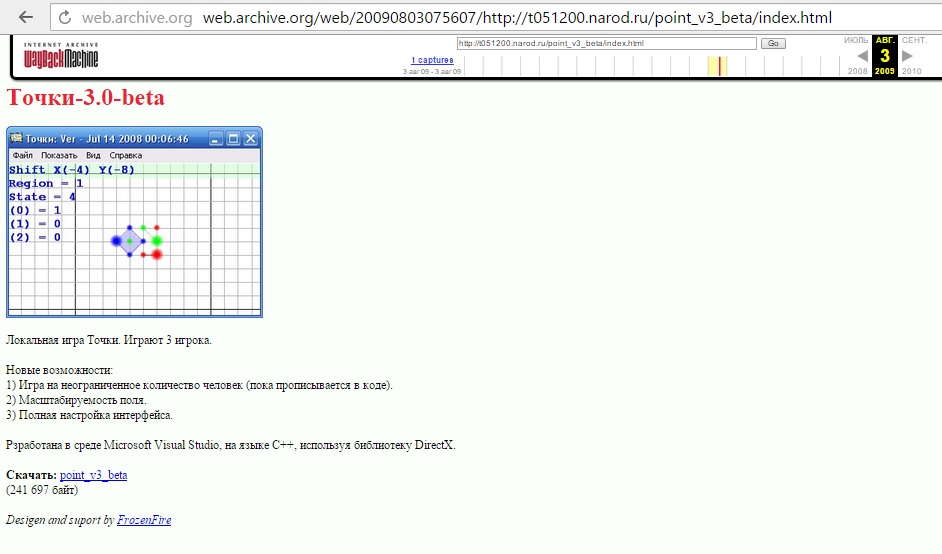
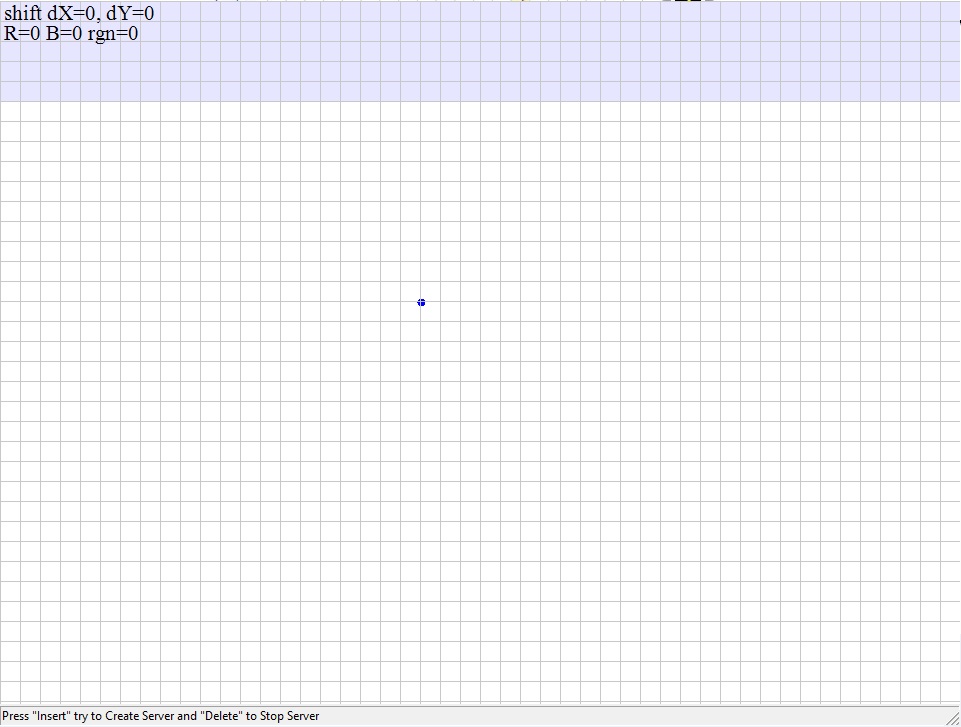
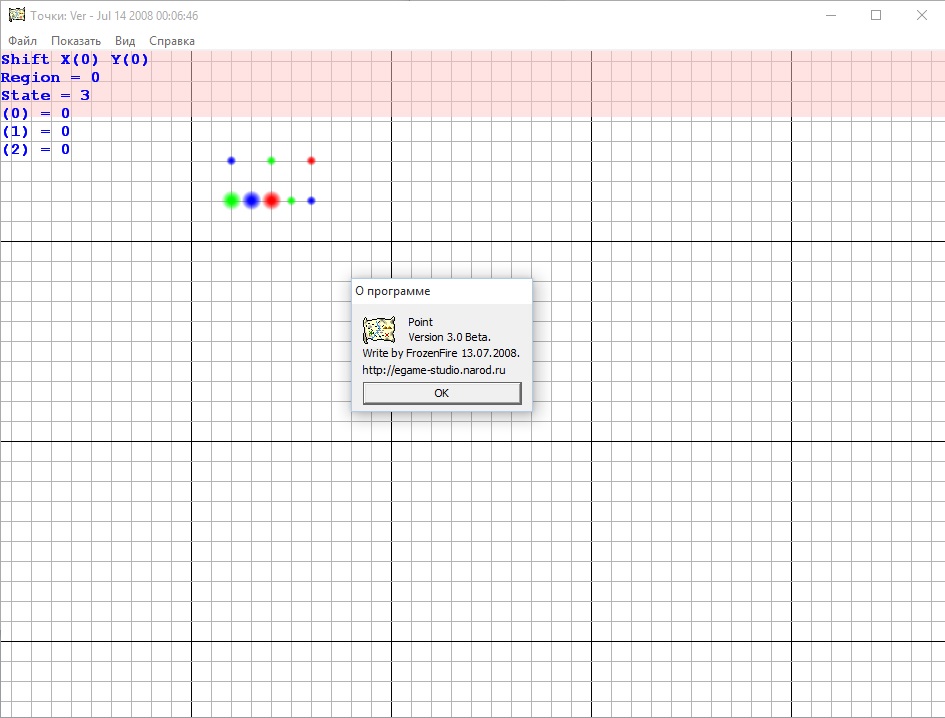
In 2008, a creator known only by the nickname FrozenFire,created two programs with the simple name Dots,The first allowed two-player games, either locally or via a remote server. The second, a one-of-a-kind client, supported a three-player mode using blue, red, and green dots. Neither client was ever finalized: they exist only as test versions, which can still be downloaded from a web archive. From a technical and functional standpoint, both clients were hopelessly outdated by the time they were released and are of interest only from a historical perspective.
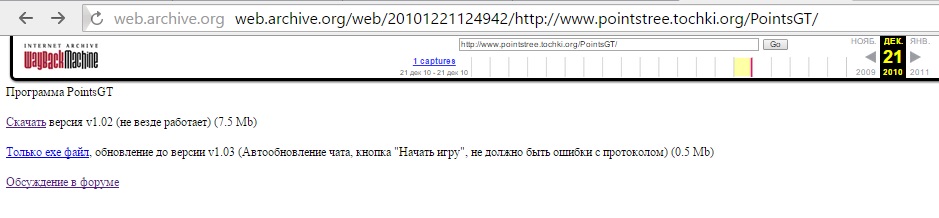
The last of the Mohicans, bringing an end to the era of computer-installed programs for playing Dots, is likely a project whose only remaining traces are an archived copy of a page dated December 2010 and the client name Points GT.No other information is available.
Inexorable progress brought other heroes to the forefront, opening new horizons and raising new problems.
Alexander Parfenov
First published November 20, 2015