
The untimely demise of the Kolnogorov project and Kolosov's "resignation" became a serious test for the Dots community of post-Soviet countries, but its state of complete disarray was relatively short-lived. Help came from an unexpected source—the West. We'll explore the details a little later, but first, let's take a look back into the more distant past.
Being a uniquely Soviet invention, Dots never boasted a widespread geographic distribution. Nevertheless, a couple of distinctive centers of development with local communities and distinct traditions did emerge on the world map. Studying the history of Polish and Czech Dots from Russia is quite challenging. Even the more or less coherent sources of information that have emerged since the widespread use of the internet are seriously hampered by the language barrier, and finding eyewitnesses and communicating with them is doubly difficult. Therefore, we will leave a detailed coverage of this topic to local researchers, should they ever appear, and will limit ourselves to the broad strokes, apologizing in advance for any inaccuracies.
Before the internet era, Dots occupied the same niche in both Poland and the Czech Republic as they did in the Soviet Union—an intellectual pastime for young students. Exactly when and by what means the game reached these countries can only be guessed at. Available evidence suggests that Polish and Czech schoolchildren were already playing Dots in the 1990s. They were likely still playing in the late 1980s, but this is only confirmed by Polish sources. The equipment used was classic: a sheet of grid paper and pens (pencils) of two colors. The game certainly didn't enjoy the same popularity as it did in the USSR and, later, in post-Soviet countries: all interviewed eyewitnesses claim that finding an opponent for a face-to-face confrontation was problematic.
The name is interesting. The Polish word"kropki"is a perfect analogy for the Russian "dots." No alternatives were found: they either didn't exist at all or were used very rarely. In the Czech Republic, by contrast, the game was called anything but "dots." The most common was"židi",which translates into Russian as "Jews." Other common names included "území" ("territories"), "hradby" ("walls"), "kasárny" ("barracks"), and "kolonie" ("colonies").
 The abundance of rule variations (with more or less unshakable basic rules), due to the amateur status and fragmented nature of the community, is as characteristic of Polish and Czech Dots as it is of Soviet Dots. However, in the Czech Republic, the local specificity, as with the name, is more pronounced. At least, the version that formed the basis of the most famous Czech computer program (repainting surrounded dots and then counting all occupied dots) is completely unlike anything else, although the author didn't invent anything himself, but simply copied what he had played on paper. The Poles, who have been cultivating an original implementation of the game of territory on their online resources for the past decade, previously, judging by eyewitness accounts, practiced, among other things, a truly "Soviet classic" game with a random encirclement trajectory, trap houses, and dot counting. An example of this is the rules and photographs of completed games from the in-person amateur tournament Kropkoliga,which took place in May 2007, preserved on the Internet.
To summarize, the following assumptions can be made. It's unlikely that Poland and the Czech Republic were independent centers of the game's origin. It was most likely adopted by local schoolchildren and students from their Soviet peers during the waning years of the socialist bloc, fortunately for them, there were plenty of ways to facilitate such cultural exchange at the time. This is supported by the similarity of audiences, equipment, basic rules, and, in the case of Poland, even the name, as well as the game's low popularity—the Poles and Czechs clearly didn't perceive the game as something indigenous, traditional, and ingrained. The game's close proximity to Belarus and Ukraine, where it has always been much more widespread than in Russia (relative to population, of course), also fits this pattern well. The Czech specificity may be due to a more creative approach to implementing foreign inventions, the indirect nature of the borrowing (for example, through Poland), and the characteristics of the community, which is objectively smaller and, by all accounts, more fragmented.
As in post-Soviet countries, the widespread adoption of computer technology and the World Wide Web gave a powerful boost to the development of Polish and, to a lesser extent, Czech Dots. In fact, Poles were initially significantly ahead of even their Russian and Ukrainian counterparts, both technologically, by creating excellent gaming programs, and socially, by quickly uniting into a small, but active and stable community.
This process began in 2001, with the launch of the Polish gaming portal Cronix,a small collection of board and card games. The first mention of it in the web archive dates back to July, but the Dots appeared in the list of available games in September (Go, incidentally, was there from the beginning).
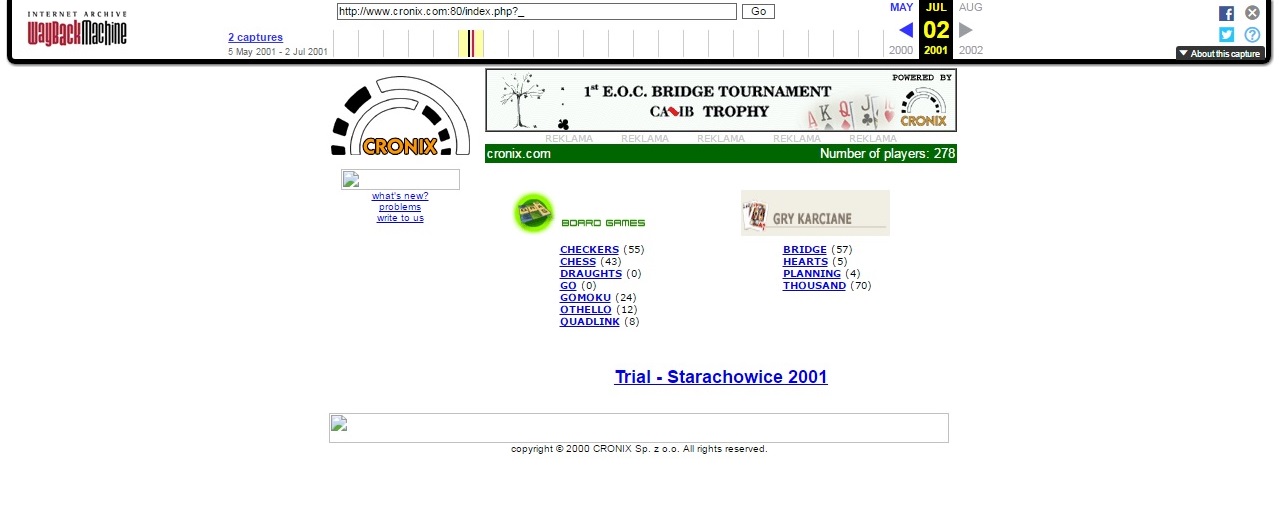
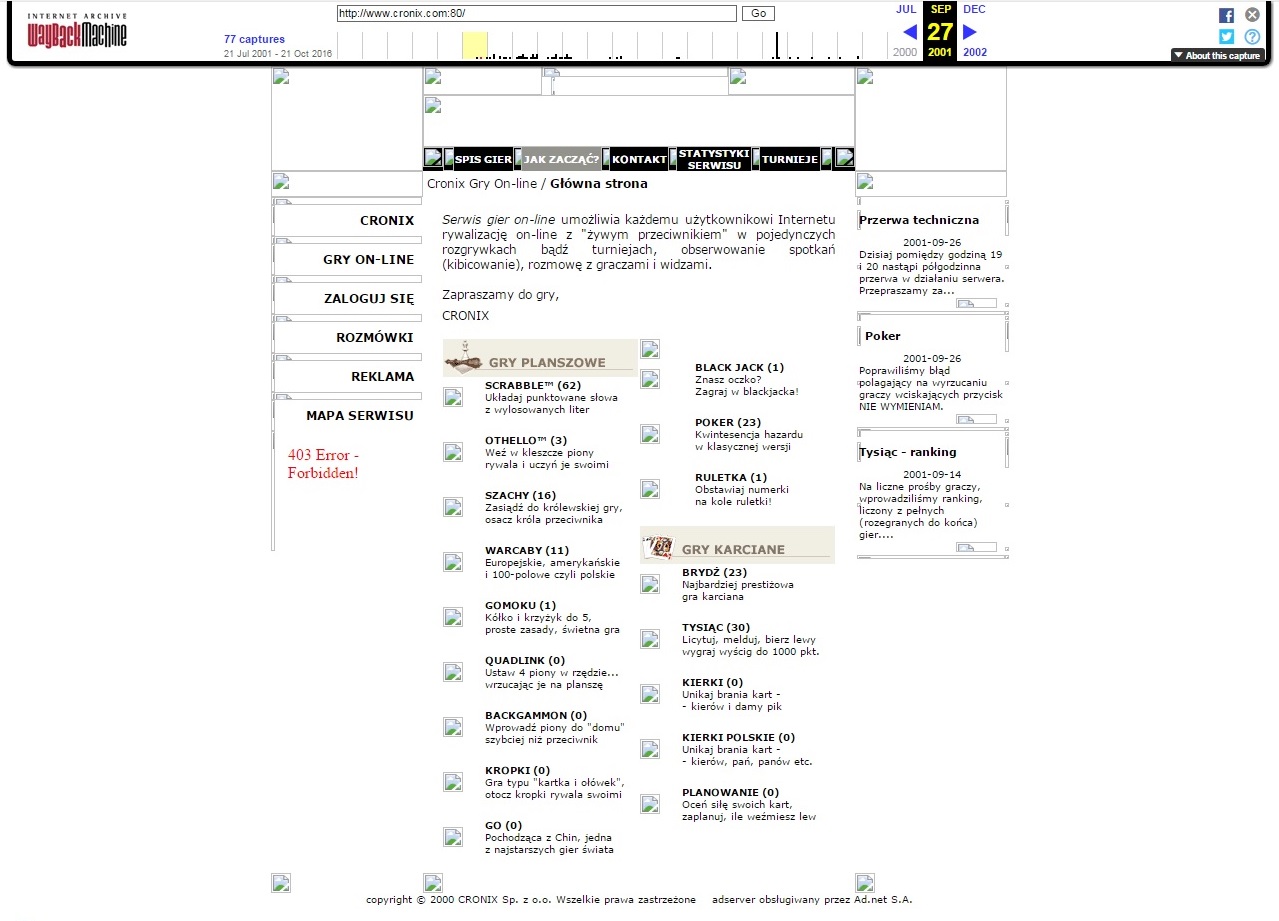
In early 2002, the site changed its address from cronix.com to zagraj.pl,and eventually came under the wing of Poland's largest web portal, onet.pl (apparently around the same time the game stopped being free). Since February 2003, the web archive has maintained a new version of the homepage, where the old brand is mentioned only in the copyright notice.
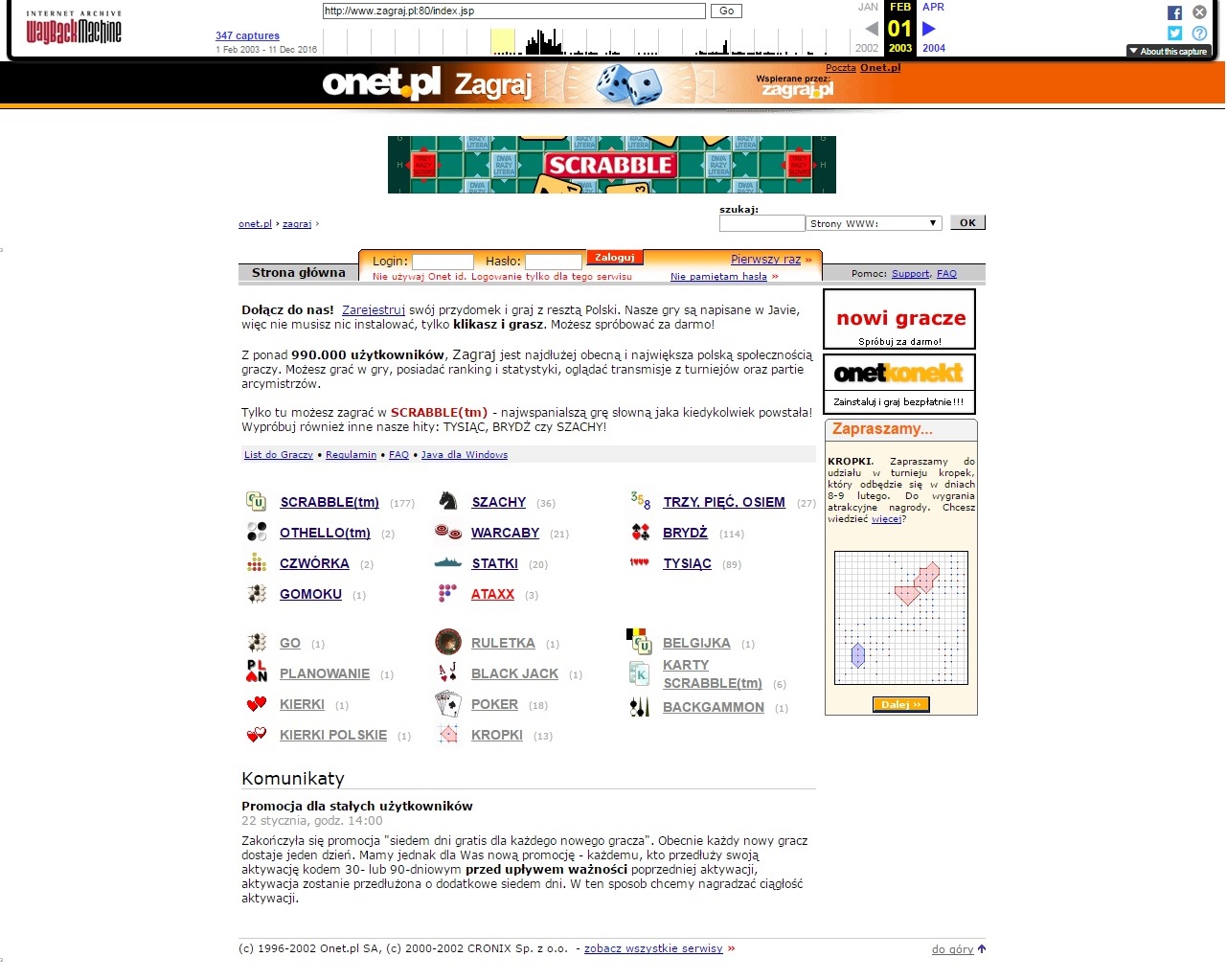
The copyright holder is listed as Cronix, a limited liability company registered in Warsaw. The names of the portal's creators and game clients are unknown to us.
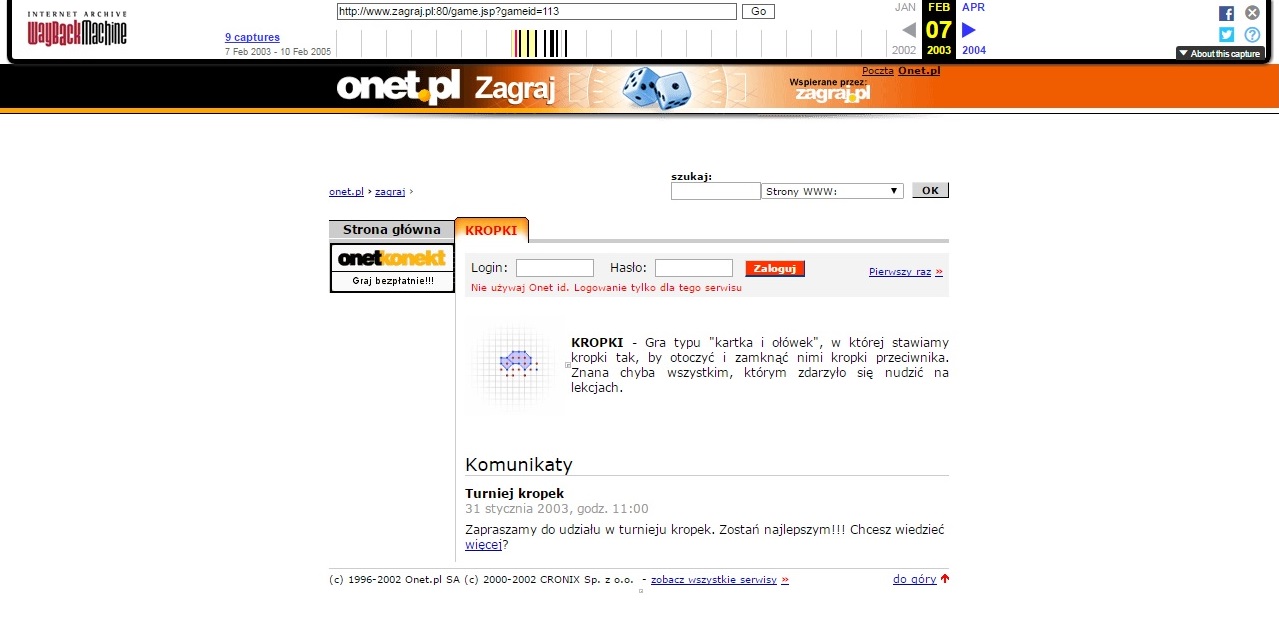
The game's description is noteworthy: "Dots is a 'paper and pencil' game in which we place dots to surround and cover the opponent's dots. It's probably familiar to anyone who's ever been bored in a lecture".Good old Soviet dots, both in the rules and in the nostalgic school-student vibes.
The exact nature of the game client itself remains unknown. It's likely a Java applet running in a browser. Currently, we only have a couple of screenshots taken no later than March 2003.
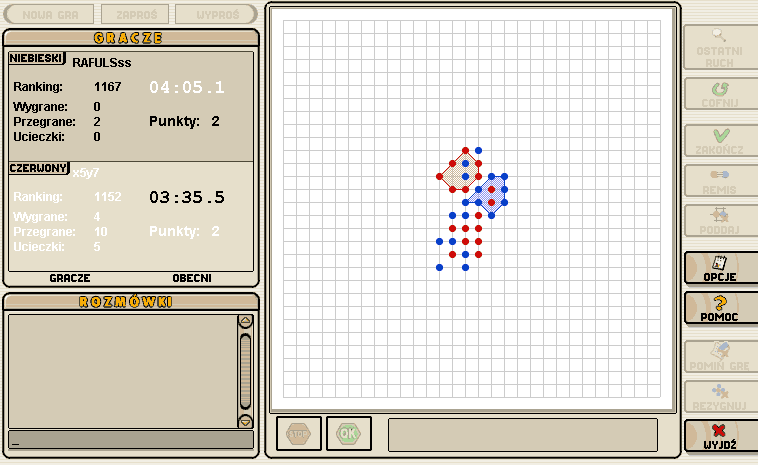
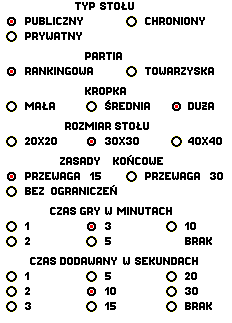
Players clearly had nicknames, a rating system (most likely based on the ELO rating), and game statistics were kept. Games began by creating a table. The board was square, with three different sizes. The appearance is quite modern: a white background, gray lines, and blue and red dots. The dot size was adjustable. Judging by the configuration of the blue encirclement, the principle of minimum area was not observed. Game time was limited (presumably according to the Fischer system), and the current score was kept in the encircled dots. The game menu is quite extensive. It includes highlighting of the last dot placed, a return move, and several options for ending the game (draw, resignation, scoring, annulment). Encirclement was controlled manually (with the "stop" and "ok" buttons). The settings include a game mode typical of Polish dots, with immediate victory upon reaching a certain score advantage. It is quite difficult to determine whether the territory was taken into account—there are no obvious indications. The social component was represented by a chat, and there was also something like a F.A.Q.
At least two client versions were released, but the appearance of the earlier version has not been preserved. In any case, even the two relatively recent screenshots make it clear that Cronix was a highly advanced product for its time, certainly not created by amateurs. In terms of functionality, it can only be rivaled by Points XT, which appeared a couple of years later. It's no surprise that this Polish project immediately sparked a frenzy.
On June 4, 2002, the first message was posted on the internet forum kropki.legion.pl,which became the main forum for Polish Dots players (the web archive began tracking it in April 2003). The first administrator, and apparently also the forum's creator, was a player with the nickname kibic777.His brainchild is still alive and well, a unique example of longevity—no other resource on the topic can match it in this regard.
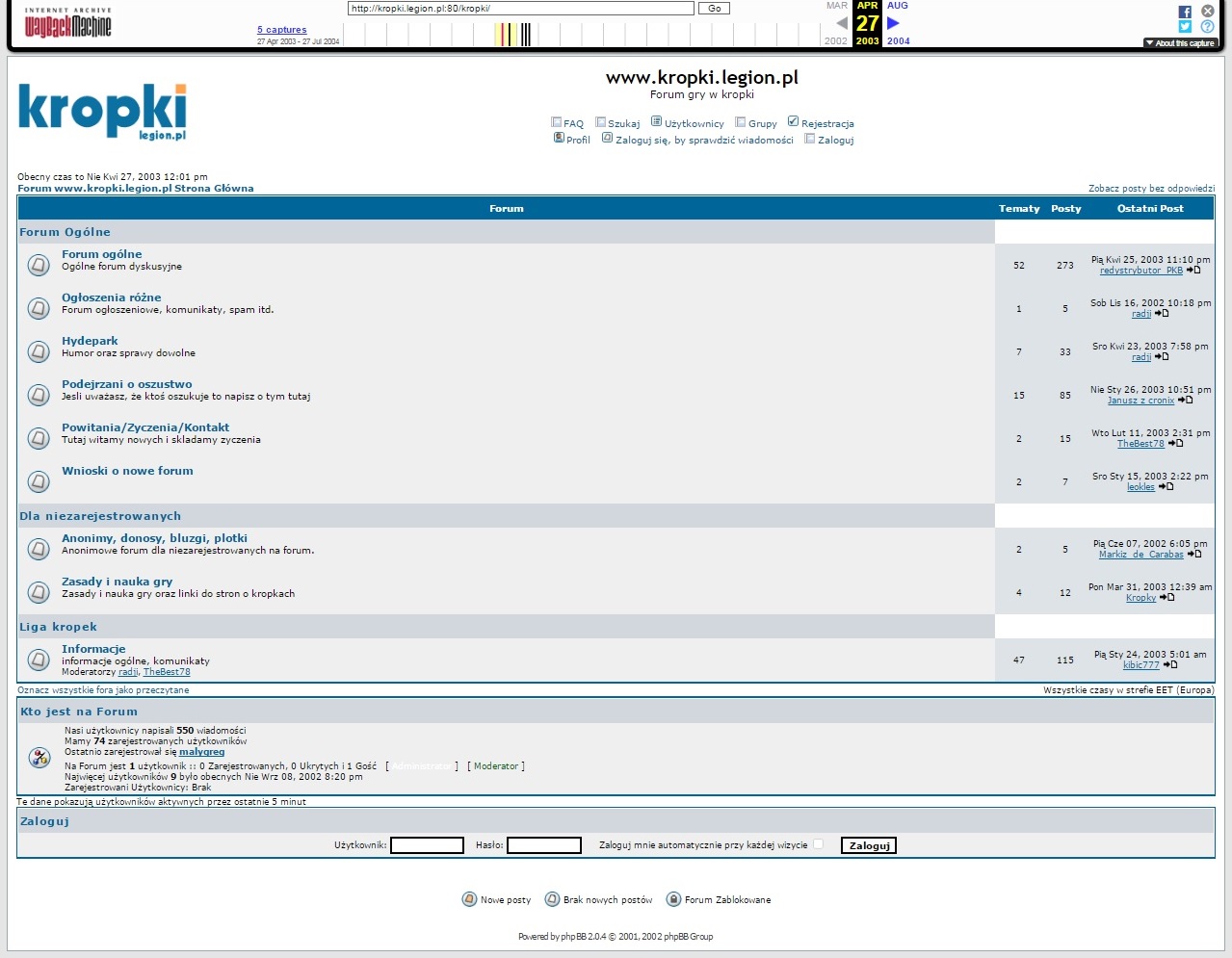
Cronix was mentioned quite frequently in the early years. The aforementioned screenshots of the client, as well as some other information about it and the project as a whole, were taken from kropki.legion.pl.
Polish players quickly embraced the idea of holding competitions—it's a central feature of Legion. The First League launched in August 2002, hosted by Cronix. The following year, a full calendar was compiled and detailed regulations were written, published not only on the forumbut also on the gaming portal.Since then, tournaments of various formats have been held relatively regularly by the Polish community.
Judging by individual screenshots from the web archive, Legion user activity, and the number of participants in the first competitions, Cronix was the most popular Dots client in the early 2000s. Points XT had a comparable audience during its heyday, and a qualitative leap only occurred with the advent of VKontakte Dots.
There were, however, problems. Cronix wasn't known for its smooth operation, as evidenced by Legion user posts and, for example, a message from the project administration, apologizing for difficulties implementing the new version, preserved in the web archive. In fact, the dedicated client didn't function for very long: it disappeared from the portal's main page no later than May 2004. Players waited for some time for it to resume operation, but to no avail.
The replacement didn't arrive immediately. Hints of alternative projects occasionally appeared on the forum, but only two of them were brought to fruition, albeit with varying final results.
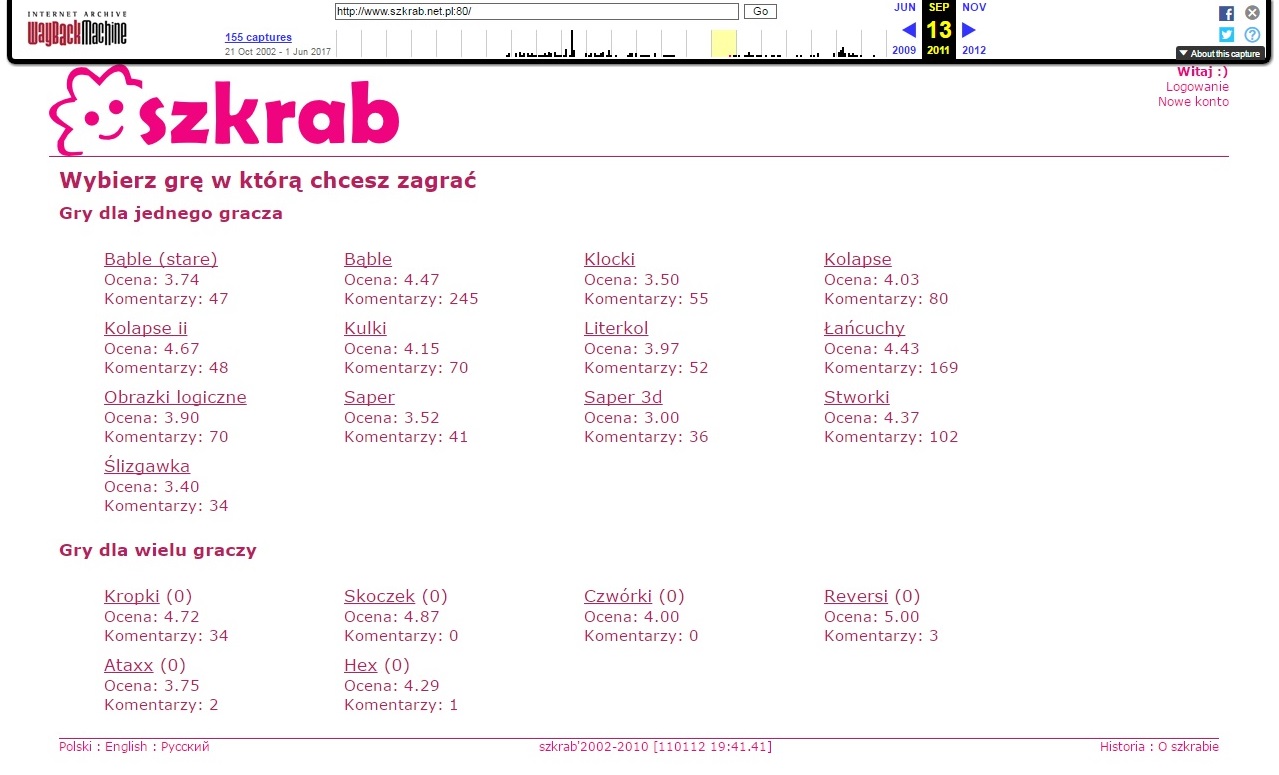
The first signs of life were shown by Szkrab.Essentially, it was a version of the early Cronix—a portal with a selection of several games. It appeared in late 2002, but without any Dots yet.
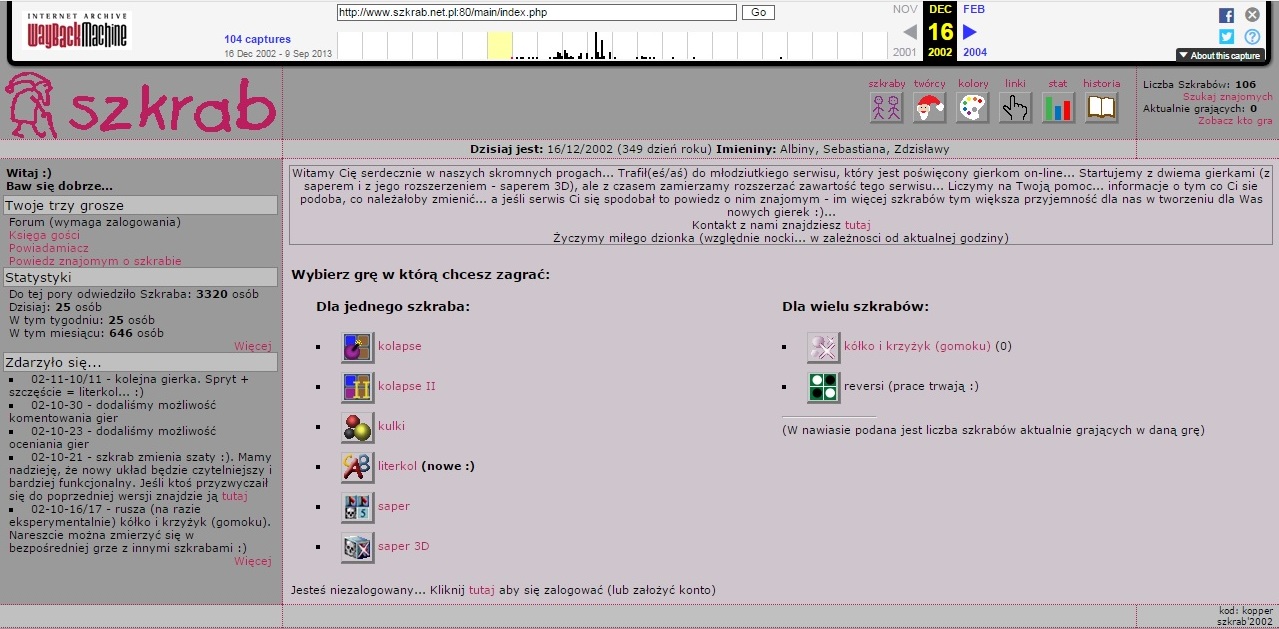
Work on the Dots client began in January, and an icon marked "in development" was added to the portal no later than October 2003. The test version was apparently available to anyone interested. Regarding the authors, we can only say that one of them was likely a player with the nickname kopper.
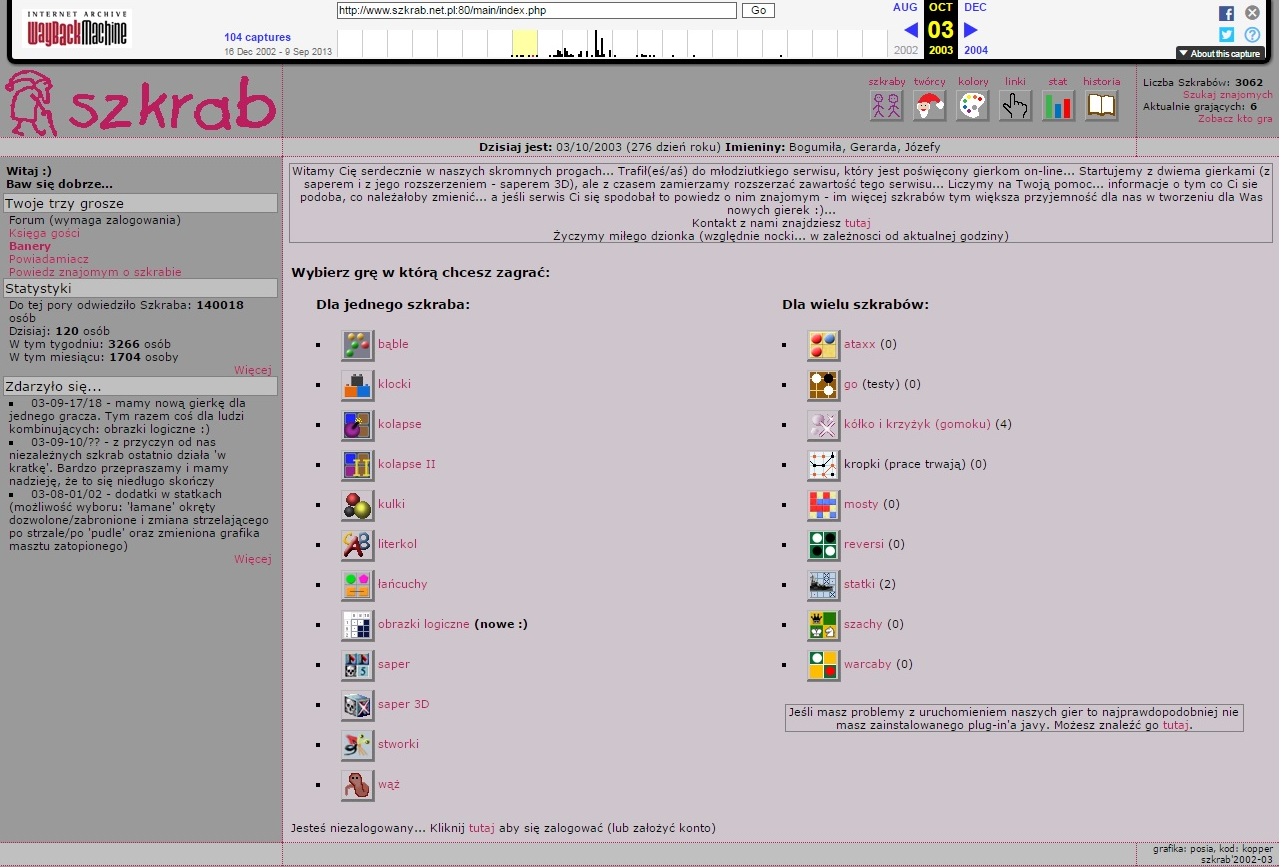
Something went wrong, however, and soon the Dots disappeared from the site. The project was safely buriedon the forum, after which it went back into standby mode.
Patience was rewarded in September 2005, when Kropki.netappeared. As the name suggests, the project was dedicated exclusively to Dots. Its creator was a certain myszkin.No screenshots of the client survive, but the web archive retains some of the site's pages.
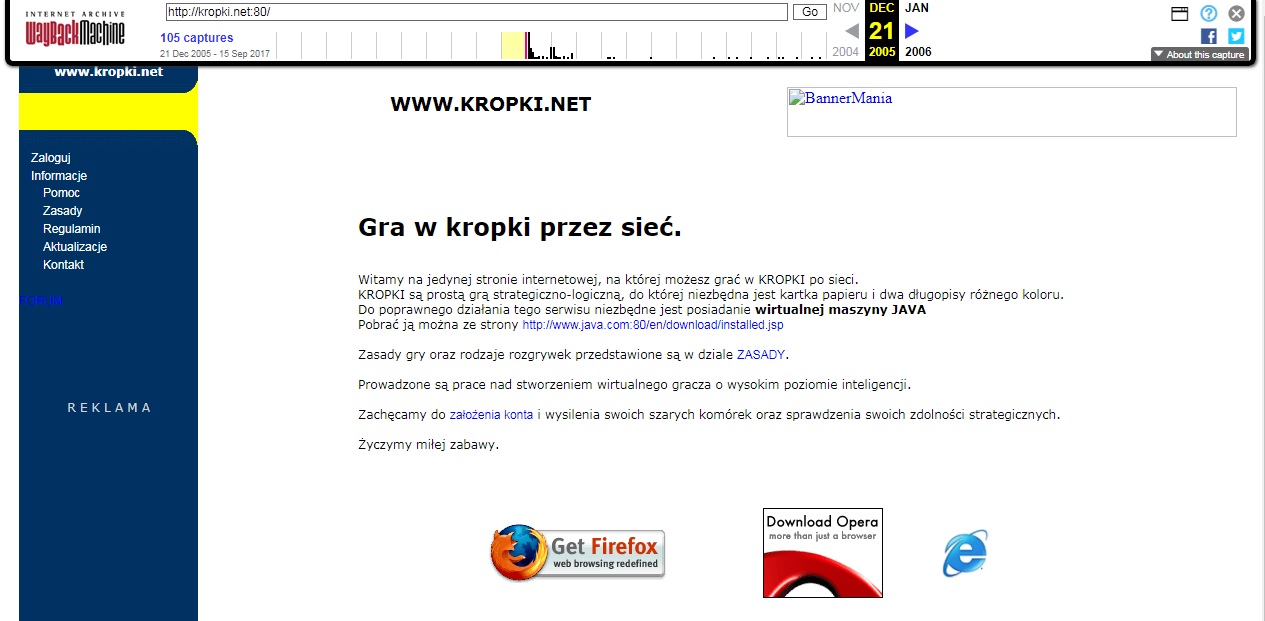
Technologically, it was apparently the same browser-based Java applet. Users registered and logged in under their own nickname. There are references to a rating system and separate tournament functionality. The board size varied, the game was accompanied by sounds, and it was possible to send messages. Unlike "Cronix," encirclement was automatic. Scores were awarded for encircled dots, but the end of the game could be determined not only by achieving a predetermined score advantage but also by filling a certain percentage of the board with dots and encircled areas.
The project developed for some time, but judging by the feedback from those who witnessed it, it wasn't particularly popular: players disliked the lack of a time limit and the automatic encirclement, which didn't always work correctly. A separate thematic forum launched by the author also failed to prove a worthy alternative to Legion (in fact, kropki.net currently redirects to kropki.legion.pl).

Therefore, apparently, the sudden resurrection of the Dots client on Szkrab in 2006 led to the project's rapid demise: the web archive records the last screenshots of the site in June 2007. This is, in general, not surprising, since the competitor was developed at a completely different, much higher level.

The new client was built using Java Web Start technology: users downloaded a JNLP file to their computer and launched the application outside of the browser (supported both Windows and Linux). It no longer works, but a detailed user manual remains on kropki.wiki.Retelling its contents is pointless, so we'll limit ourselves to a couple of screenshots and a brief description.
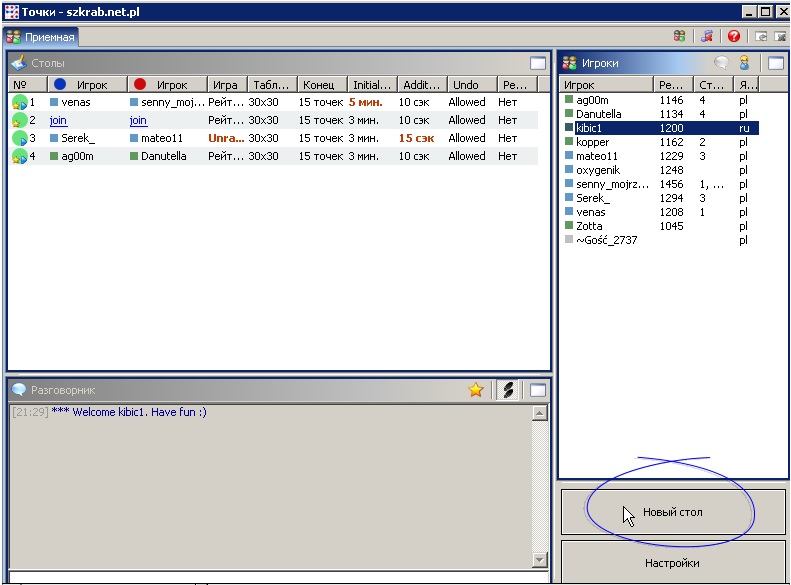
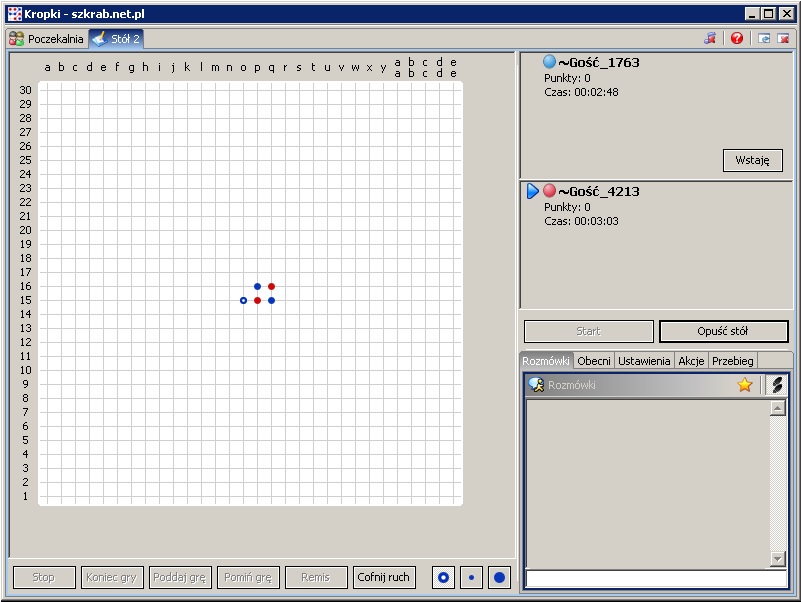
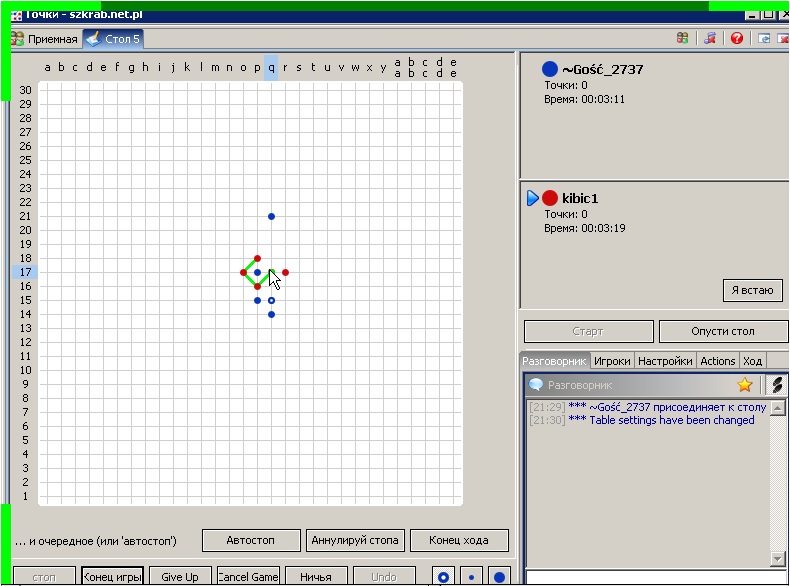
The general continuity with Cronix is apparent at first glance, but the technological and functional progress is also obvious. Two types of users: guests and registered players. A rating system with color-coded ranges. Detailed game statistics, including such things as a rating change graph and head-to-head results. A game archive with the ability to "clone" and export to SGF. A playing field with an alphanumeric coordinate grid and five available sizes. Extensive visual settings (color and size of dots, game field tint). Fischer time with the ability to add seconds to your opponent. Starting a game by creating or joining a table, game settings templates, and "busy" status. Invite, game resume, and dot placement sounds. No starting crosses. Handicap mode in addition to the traditional advantage win. Manual encirclement, undo moves. The same several game ending options: draw, resignation, scoring, annulment. An extensive social component: avatars, chats (including private ones), a contact list, and useful links. Three languages: Polish, Russian, and English. Finally, the client's main highlight is the so-called Polish rules of the territory game, which, apparently, were finally established on Szkrab and have become not only the dominant variation of Dots in Poland, but a kind of community signature. The essence of these rules, in general, is that when calculating scores, not only dots surrounded by the opponent's "stop" button are taken into account, but also empty points located within unfinished areas of the encirclement regions and/or houses. The principle of minimum surrounding area is not observed, and there is no landing.
The client architecture was finalized by 2009. At that time, it was arguably the best program for playing Dots based on its overall characteristics (if we leave aside the differences in rules, of course). The only drawbacks were its reliance on the Java platform, which required additional user interaction and was generally outdated, and its extremely functional design (another characteristic feature of Polish projects). Furthermore, Legion frequently encounters player complaints about access issues, the causes of which are difficult to pinpoint.
The client lasted significantly longer than Cronix, becoming the main gaming platform for the Polish community for several years (in 2011, the portal redesigned its main page, and the latest screenshots in the web archive are from 2015). Tournaments were held on Szkrab, where top Polish players such as Jakub Zurawski , aka kubusio,honed their skills. Their style, apparently shaped by territorial play, was characterized by caution and positional awareness.
The Polish Dots-based infrastructure has become particularly attractive with the emergence of a resource called EidoKropki.This browser-based client,which allows viewing and analyzing previously played games, was created by Justin Kramer,a programmer and Go player. In fact, it was originally designed for Go, and the Dots-based modification was created by mathematician Bartek Dyda.Judging by screenshots from the web archive and the last update date of the kropki.wiki page, this occurred no later than February 2009 (the Go version has been running since 2007).
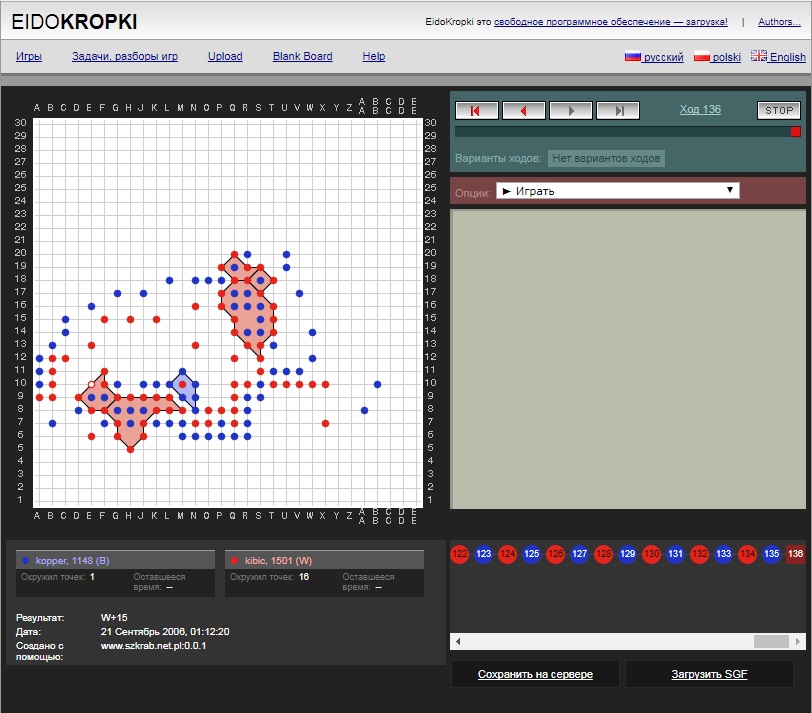
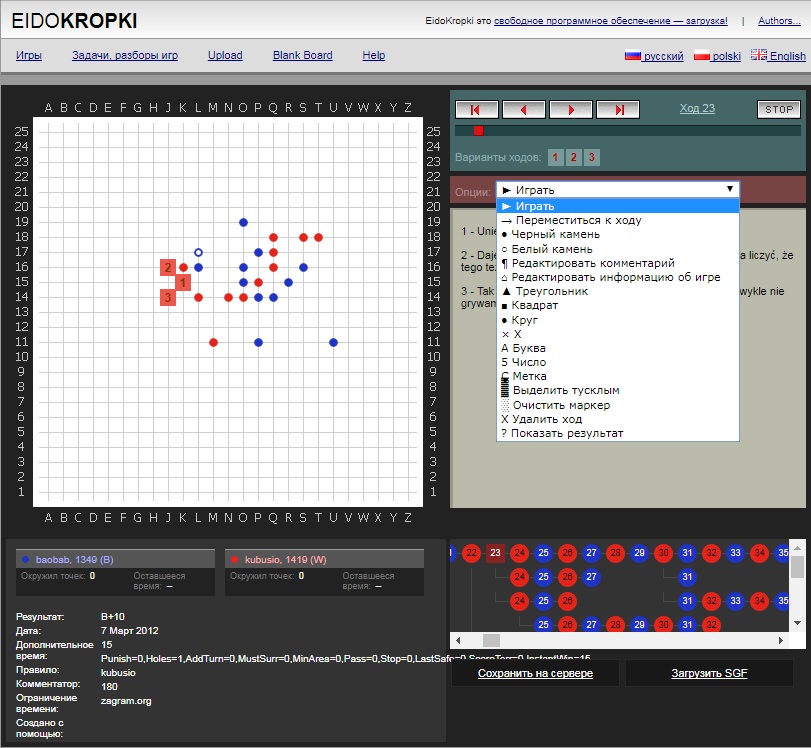
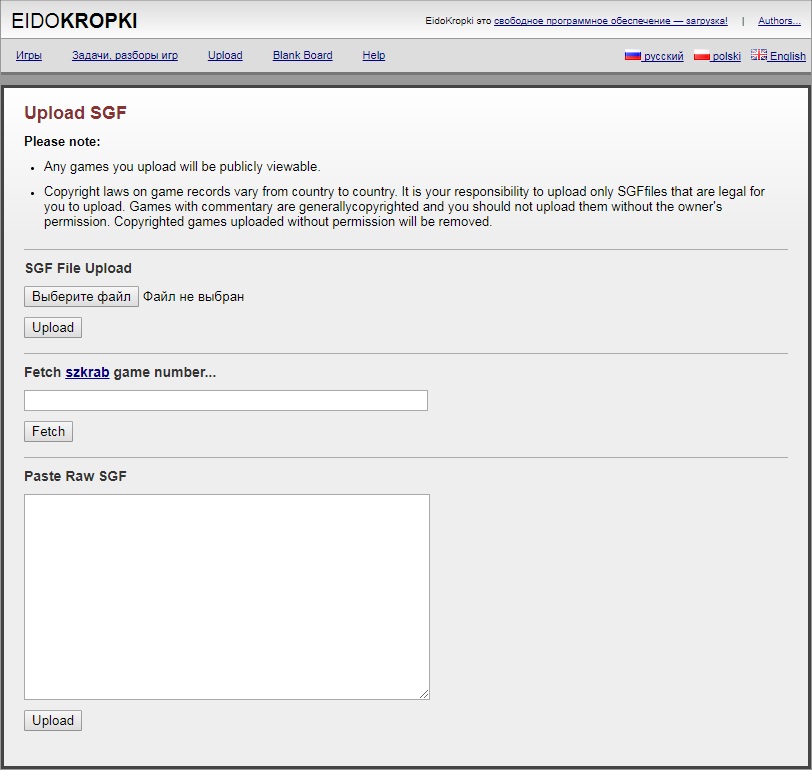
The client is connected to a server that stores a huge number of games. This archive is constantly updated through the manual addition of SGF files, as well as their automatic saving to connected game platforms. The functionality allows you to view games, create compositions, create and save an arbitrarily complex tree of variations for each move, leave text comments, and make various marks on the board. It's a unique, simple, and accessible tool for learning and improving your playing skills.
On this upbeat note, let's briefly digress from Polish affairs and move to the neighboring Czech Republic. Not for long, because very little information remains about Czech Dots from the internet era.
For example, of the first game program created in the Czech Republic (of those that were discovered), only the name and a brief description remain. It was created by a person with the nickname Tramp,who, at the turn of the millennium, posted his own page on his personal page.
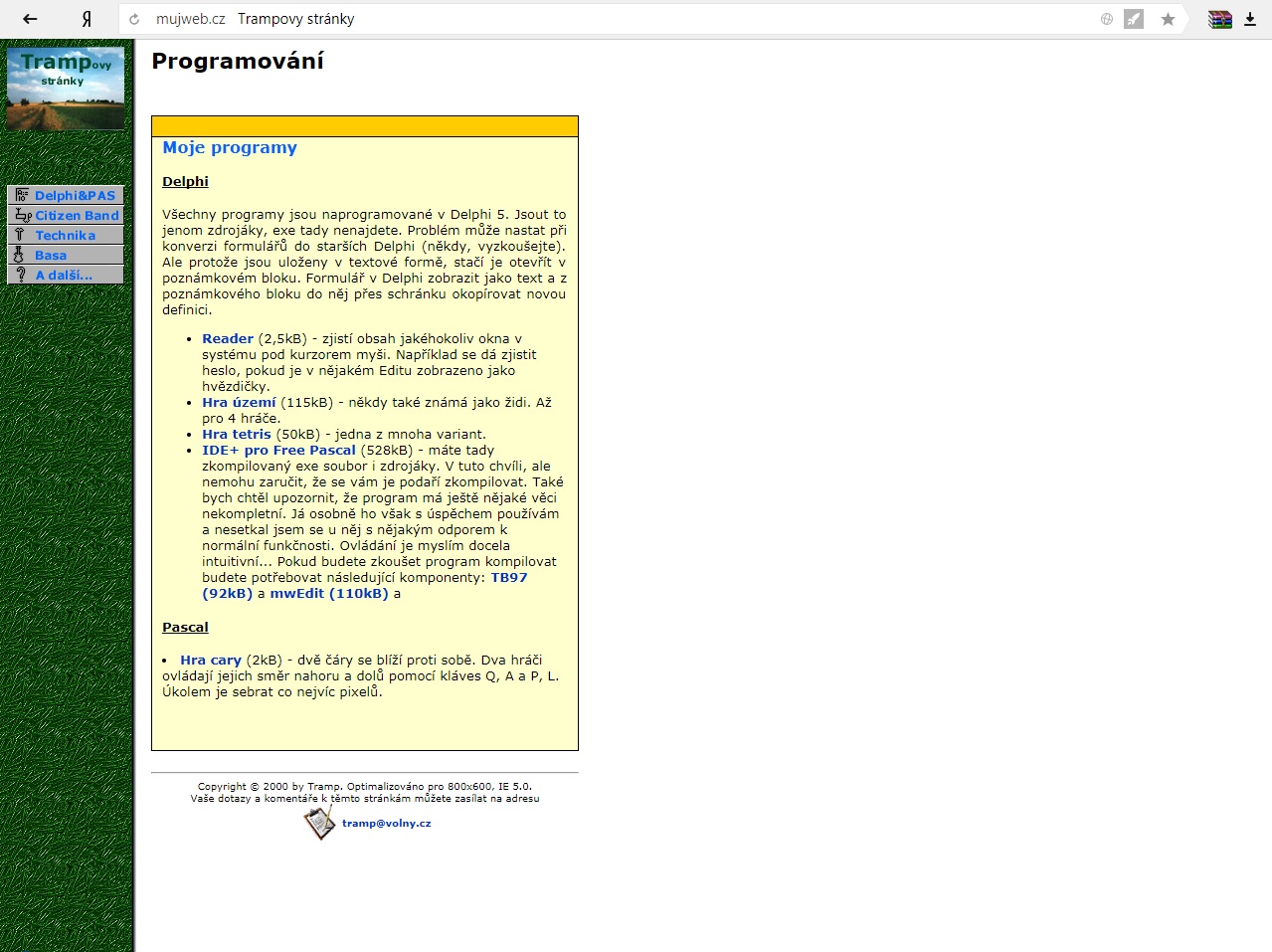
The page still opens, but the program, unfortunately, is unavailable for download. The description suggests it was written in Delphi, took up 115 KB of memory, and could be played with up to four players (unlikely online, of course). Interestingly, in addition to the game's main title— Území —there's also an additional name—"židi." Judging by the copyright, the program was created in 2000, which generally correlates with the level of technology used by the author.
A more substantial attempt to secure a place for Czech locations on the internet was made in 2002, when, judging by the copyright on the only surviving screenshot, another game client appeared. It was called Kolonie.
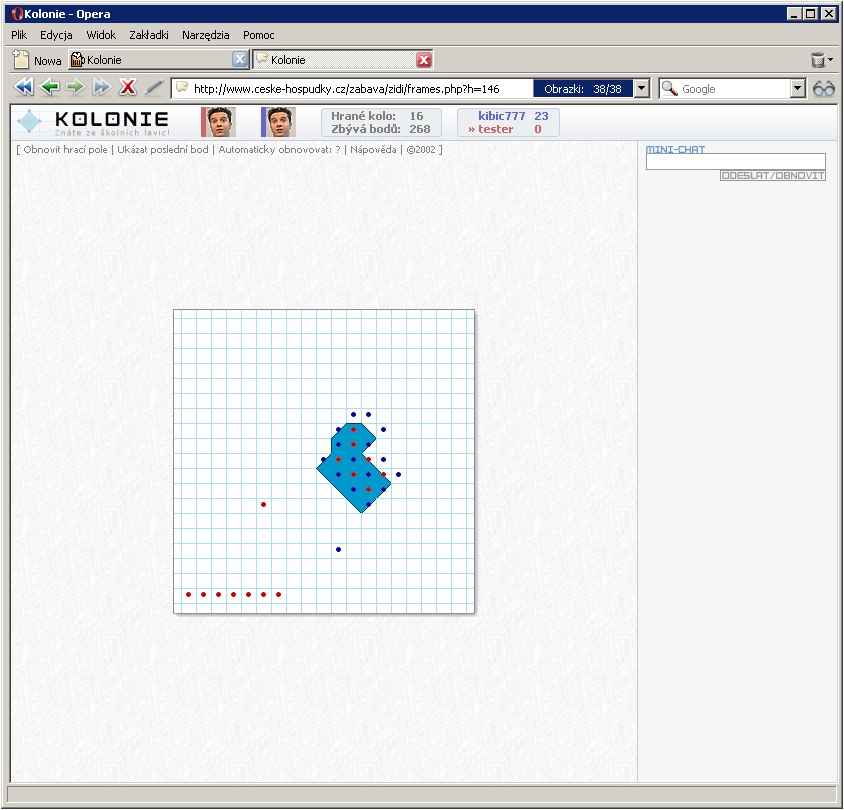
This was a browser-based online game client hosted on a websitededicated to Czech restaurants and other entertainment venues. It's hard to say why the site's administration needed the Dots. Apparently, it was to retain visitors, who were supposed to be drawn in by the characteristic slogan "familiar from school." The client allowed players to play under their own nickname on a 20x20-dot board. The color scheme was classic: gray lines, blue and red dots. The features were minimal: automatic or forced board refresh (the purpose of these actions, frankly, is unclear), a display of the last move, a F.A.Q., and a mini-chat. As the game progressed, moves and remaining dots were counted (presumably, the game continued until three-quarters of the board was filled). The encirclement region looked normal, but the scores were calculated in a peculiar way: apparently, all points lying along the perimeter of the area and within it were counted, regardless of whether they were free or occupied by dots of any color. The project's audience is unknown. The client was still active at the end of 2007, as information about it appeared on Legion on December 28th. Its subsequent fate remains shrouded in mystery.
 Finally, the most famous Czech program for playing Dots is Židi.It was written by Milan Pidman aka PiDi,a former student at the University of West Bohemia, and the first and only version (1.0 beta) was released on March 31, 2006. You can still play it today—the program is available for download and works perfectly. Incidentally, the author was also eager to share information about his development. The backstory is simple: Milan first encountered Dots at school, where he played with his classmates on paper. Later, while studying at university, he wanted to find a program for playing the game on a computer, but finding nothing, he decided to create his own.
After downloading, the client opens in a separate window. The interface is simple, the design is minimalist. Progress animations add variety to the gameplay: funny smiley faces instead of avatars, dominance bars, and a position thumbnail. You can play against artificial intelligence, remotely via LAN, or against yourself. The board is rectangular, with a single size (50 by 40 points). The color scheme is unique: light gray lines on a dark gray background. The dots are blue and red. The coordinates of each point are displayed in a separate window when you hover over the board. The last move is highlighted, and there is a soundtrack. There is a timer, but the game is unlimited. The game continues until the board is full, with no early ending options. Games can be saved as a file, and saved ones can be loaded and played again. The main features of the client are, of course, the encirclement and scoring rules. In fact, there are no encircling regions as such: a player's dots, surrounded by an enemy chain, simply change color to the opposite. Empty points within the encircling area are not removed from play, and dots of a different color placed there continue to change color. It's impossible to encircle a house with the last move—the dot is lost. Scores are awarded for the number of dots of the corresponding color on the board (one-to-one).
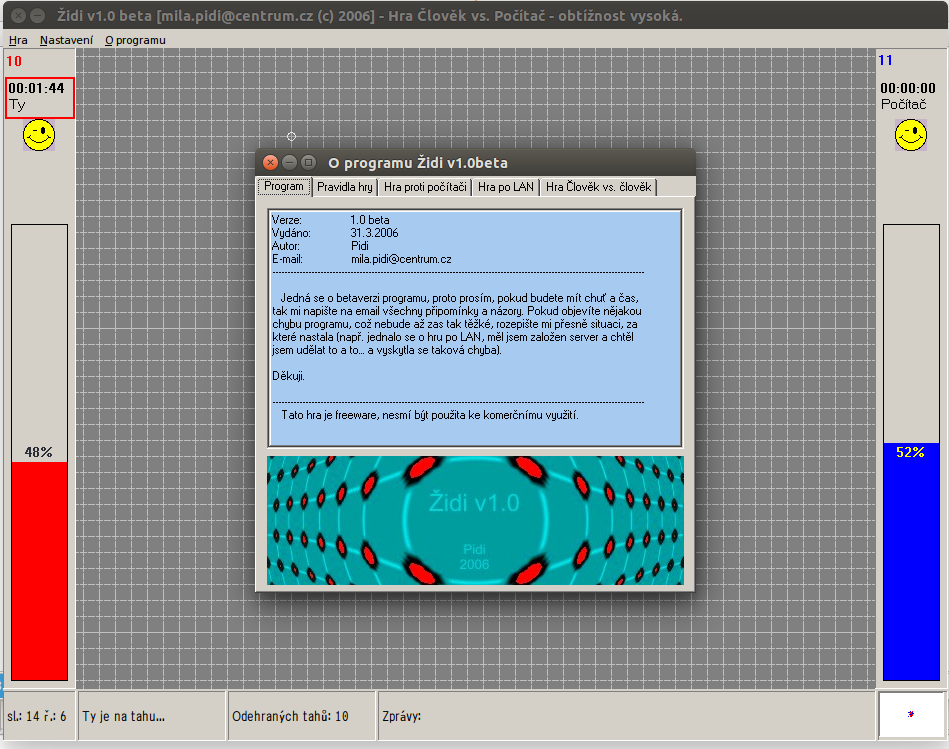
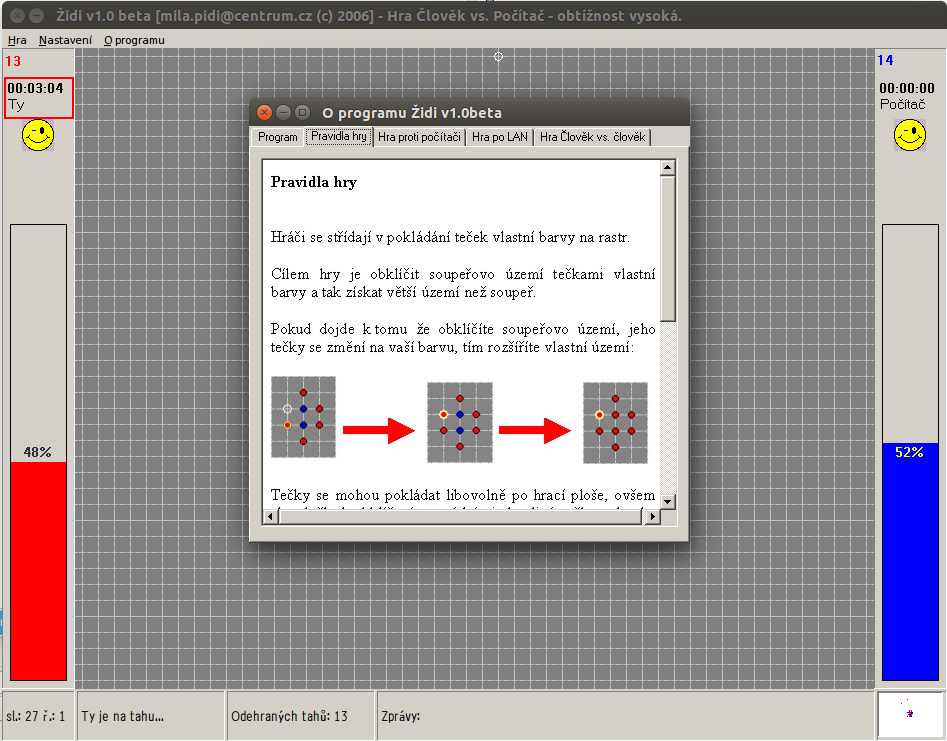

Overall, it's a fairly high-quality amateur development, too specific to spread beyond the Czech community, and therefore hasn't seen further development. According to the author, it has been downloaded just under three hundred times since its inception, and this, apparently, isn't a symptom of any flaws in the client, but rather an objective indicator of interest in Dots in the Czech Republic. The same applies, for example, to the lack of themed resources like the Polish Legion, serious tournaments, and famous players. Clearly, the efforts of isolated enthusiasts couldn't change the situation, so, having started almost as quickly as their neighbors, by the late 2000s the Czechs had fallen by the wayside and watched the further evolution of Dots from the sidelines.
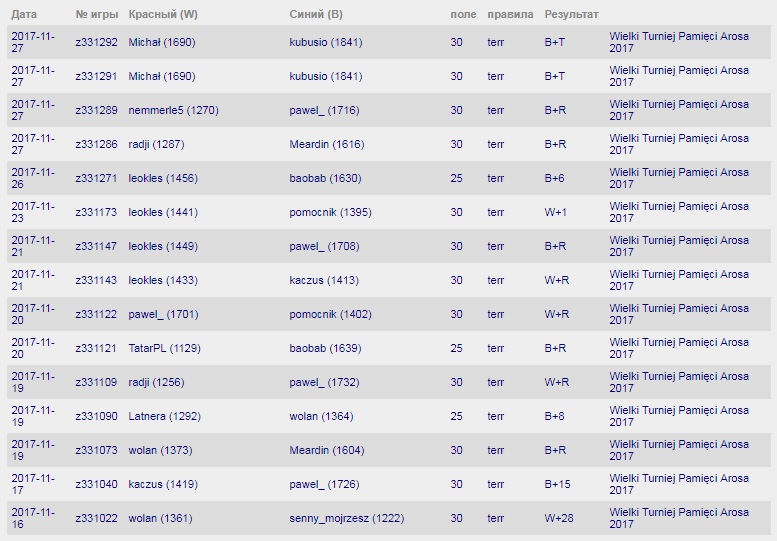
Meanwhile, the Poles continued to confidently forge their own path. The community had everything it needed: its own gaming and social infrastructure, its own vision for the game's future, its own traditions, and informal leaders. Among the latter, one could count, for example, Senny Mojrzesz,who has been the main inspiration and organizer of various competitions for two decades now. The Polish community's most vibrant tradition, the Arosa Memorials (Wielki Turniej Pamieci Arosa),is also associated with tournaments. The first of these took place in late 2006, and since then, these tournaments dedicated to the tragically deceased player have been held regularly, invariably attracting large numbers of participants—a remarkable consistency! Promotional efforts were also addressed. For example, an interesting example of target audience engagement is the interactive description of Dots posted on the website of mathematician Jakub Grzegorzek. It appeared no later than October 2007 and initially sent interested users to "Szkrab".
Nevertheless, Polish Dots cannot be called islands of absolute prosperity. Their main problem, as seen from the outside, is a continuation of their strengths and lies in their distinct isolation. While isolation was objectively inevitable in the "paper" era, with the advent of the mass internet, subjective factors came into play. By the time Szkrab established itself in the West, standards had long reigned in the East, the benchmark generalization of which became the rules of Points XT and the first Kyiv tournaments. Therefore, the Poles' introduction of the game to the region, dividing Dots into "Polish" and "Russian" (regardless of the pros and cons of these variations), effectively cut them off from the post-Soviet audience—the reluctance to abandon their own principles was mutual. Meanwhile, the influx of local newcomers never ensured even minimal growth of the Polish community—it always remained stubbornly small (suffice it to say that "Legion" has registered fewer than six hundred users in fifteen and a half years). As the Java platform on which Szkrab was built became technologically obsolete, the problem only worsened—the number of active players dwindled.
 Finally, in 2010, the already familiar Bartek Dyda and Jakub Grzegorzek took on the challenge of overcoming the emerging stagnation. Their brainchild, Zagram, ultimately became the most successful Polish project and made a significant contribution to the game's development. Perhaps the main component of this success was the creators' working style, which can be summed up in two words: responsibility and openness. Despite its amateur status and the complete absence of "commercial" elements, development was carried out with the utmost quality and professionalism, and user feedback was organized in a way that was far from mere formality. This was captivating and motivated fruitful collaboration.
 The first traces of the resource in the web archive date back to October 2010, but it launched several months earlier: the comment feed began on July 25th. Unlike Szkrab, this was a portal entirely dedicated to Dots (the tab with the "balls" puzzle can be ignored). The client was browser-based, using HTML5 and JavaScript. The release version wasn't particularly feature-rich, but development was quite dynamic, and within a year or two, Zagram had become a fully-fledged gaming platform, essentially unrivaled. The project's audience also grew quite quickly, and a significant, if not decisive, role in this process was played by the fact that Bartek and Jakub didn't limit themselves to the traditional local model. Just six months after its launch, the client began supporting Russian rules alongside Polish ones, and the chat became replete with Cyrillic. Strategically, this was the right decision, which, coupled with the bleak situation of the eastern community left without shelter, brought most of the strongest players to Zagram.
The portal is built around a game client. Its architecture and appearance clearly point to a direct relationship with its predecessors, but in terms of the number of features and the quality of their implementation, Zagram is unrivaled. Essentially, it is the result of the condensed and creatively reworked experience of computer Dots development, and not just Polish ones.
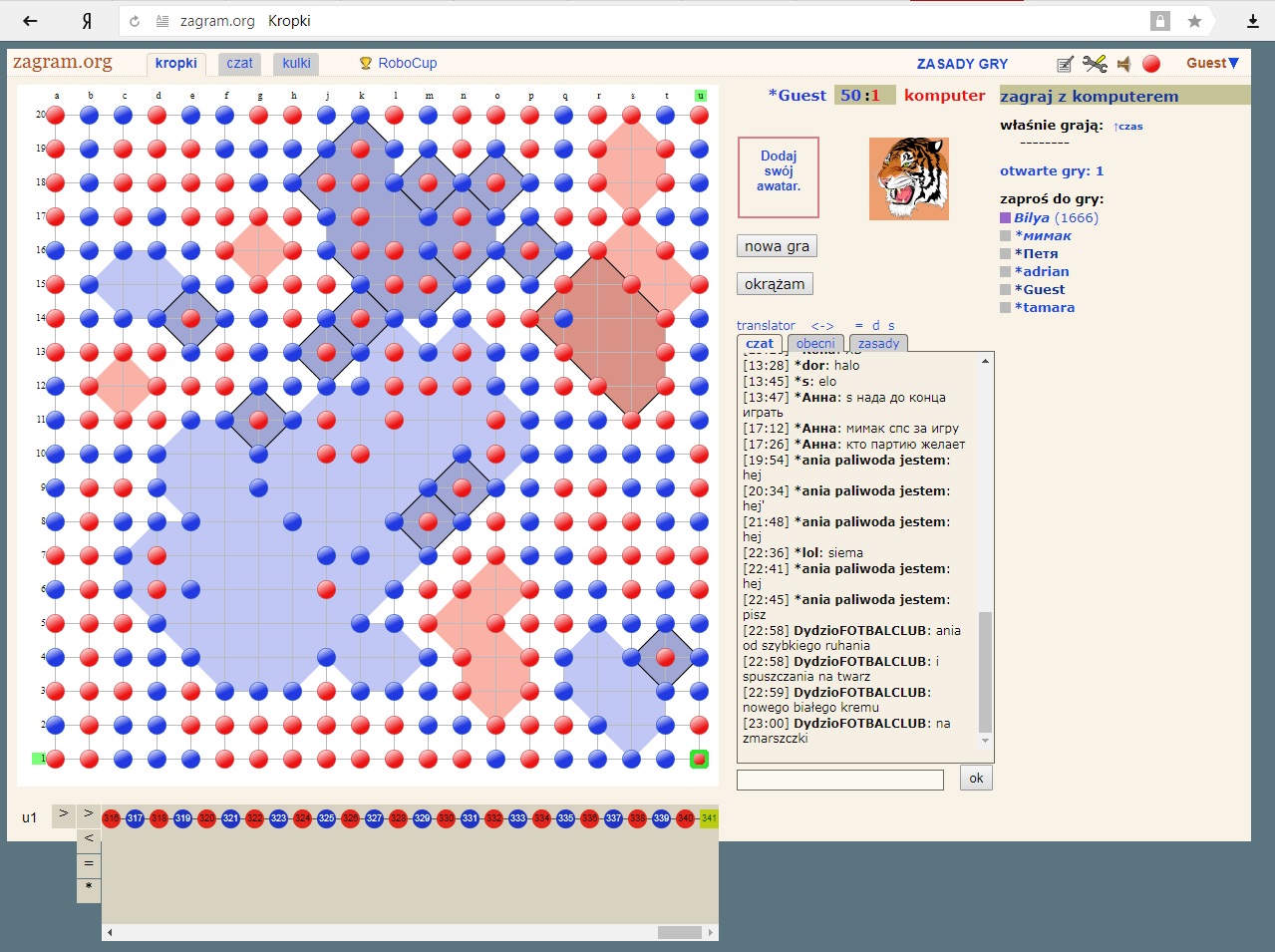

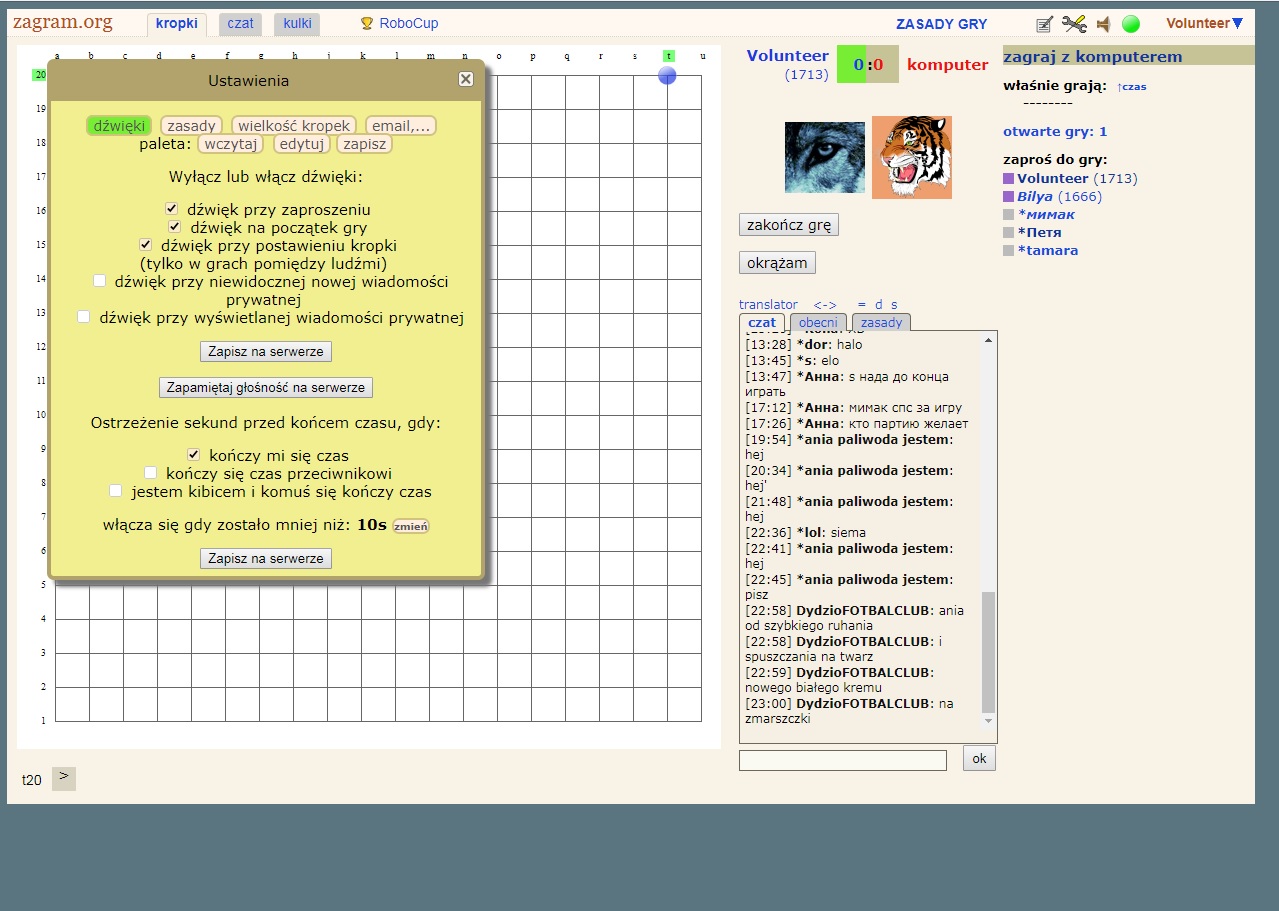
Users have access to a guest profile with limited features and a full profile, which is very easy to register. A personalized description and avatar can be added. The rating system is similar to that on Szkrab, as are player statistics (graph, head-to-head matches, average opponent rating). The client is integrated with EidoKropki, where all played games are automatically uploaded. "Cloning" via an SGF number is available. Virtually everything can be visually customized using a color code or diagram: windows, functional areas, backgrounds, headers, typed text, the playing field, lines, dots, encirclement regions, and much more. Dot size can also be adjusted. The sound collection includes game invitations, game start and resume, dot placement, time-out warnings, and receiving a private message. In addition to traditional table creation, a specific player can be summoned from the online list. A "busy" status is also available, along with the ability to block a user, which depends on their profile type and "stability." Eight board sizes, including a 39x32 "notebook" size. Alphanumeric coordinate grid. Three types of time control: unlimited, with a margin and incremental seconds (Fischer system), and with a margin and time per move. There's also the option to add seconds to your opponent's time (can be disabled in the settings).
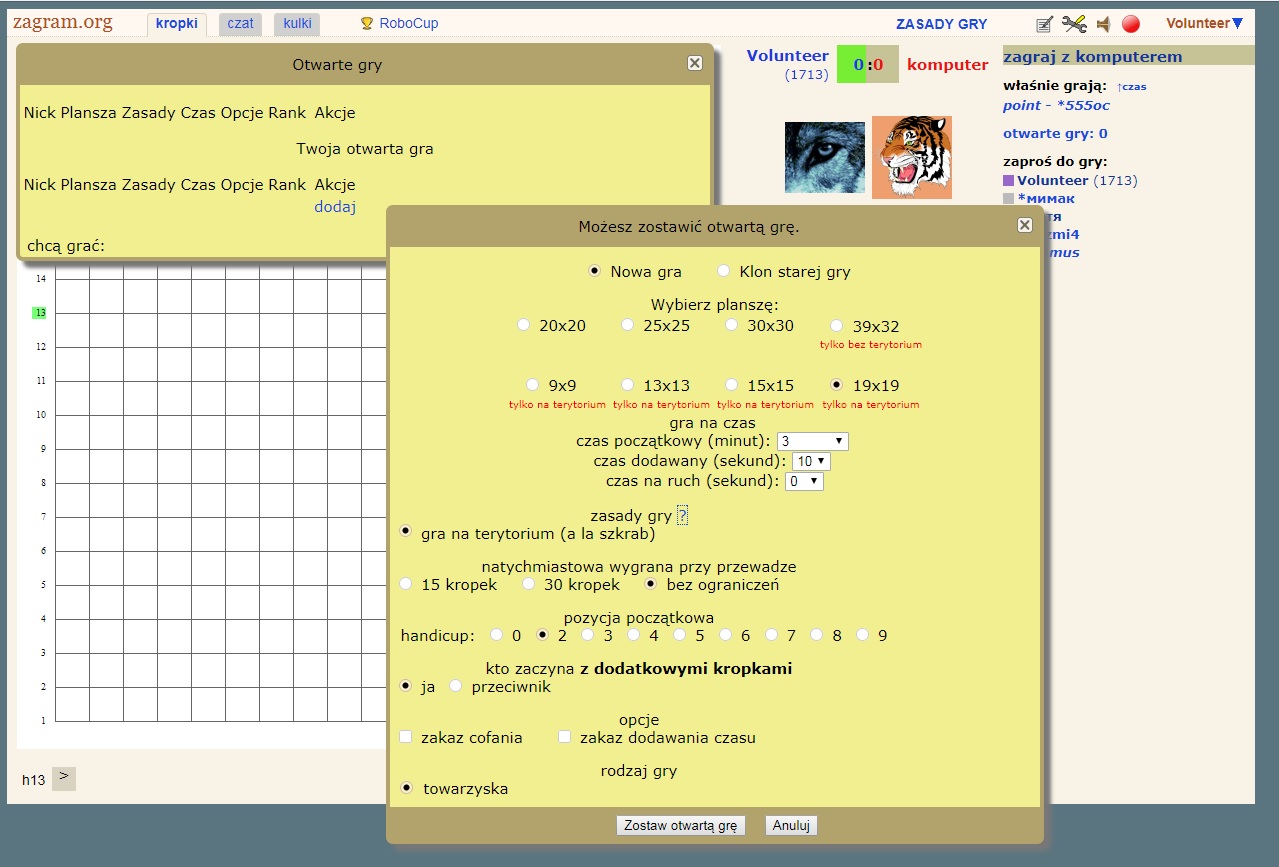

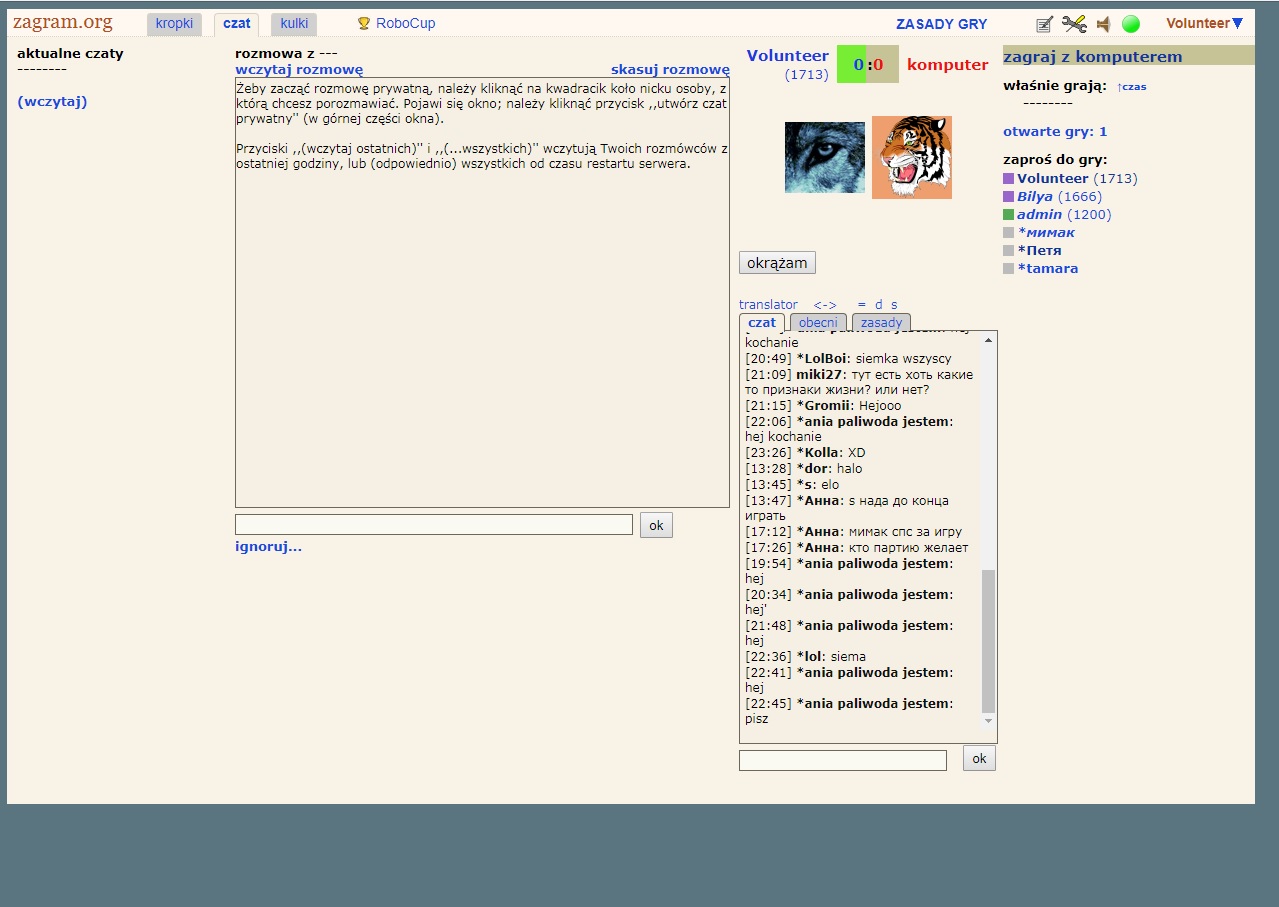
There are two main game modes, which determine the available settings: territory and no territory. The first mode is generally self-explanatory—the differences from Szkrab are minimal. The only difference is that the encirclement can be closed not only manually but also automatically (while adhering to the principle of minimal trajectory). In the no-territory mode, initial crosses (single, double, four singles), landing, and group games (2v2, 2v1, 3v3, 3v2) are available. There are no specific or ambiguous modes, such as an extra move. Default settings can be saved on the server. Undo and disabling moves are also available. The social interface features general, in-game, and private chats. In addition to Polish, Russian, and English, Ukrainian is also supported, with built-in Google Translate translating chat content. The client is highly reliable and fast.
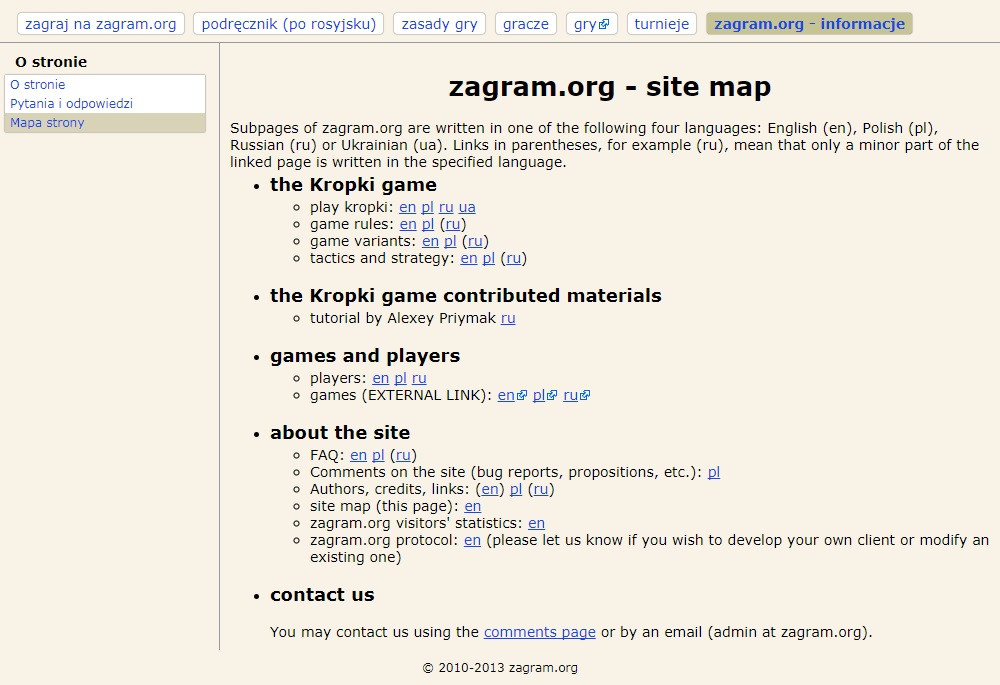
Over time, the portal's content also expanded. The result is a kind of encyclopedia, compiled with the help of some players. Here you can find a site map, information about the authors, frequently asked questions, game rules and basic techniques, Alexey Priymak's textbook (more details below), a rating list, a game archive (link to EidoKropki), and a list of tournaments held on the platform with detailed information.
It's probably no exaggeration to say that as a standalone client, Zagram is close to ideal. The only serious drawback is its garish and rather primitive design, which affects not only the aesthetic appeal but also, given the abundance of features, the user-friendliness of the interface. The cell scale, which varies depending on the field size, also creates certain inconveniences. Furthermore, the alphanumeric coordinate grid, traditional for Polish clients, doesn't seem particularly suitable (though this only becomes noticeable when there are more horizontal dots than Latin letters). Another issue is that the very concept of a standalone client, even a browser-based one, has largely failed the test of time.
 Here we need to return to where we began. The post-Soviet countries' Dots community entered 2011 without a proper gaming platform, without information resources, without a reputable organizing center. A handful of activists, huddled on the hopelessly outdated Points XT, had to find a way out of the crisis. Six months of trial and error resulted in the creation of pointsgame.net, a thematic website with a forum mentioned in a previous article. At the forefront of this project were server owner Vasily Novikov, along with the most active content creators: Priymak, Oleg Anokhin aka Oxin, and someone hiding behind the pseudonym Zagadka (his real name remains a mystery). This collaborative effort generated a surge of enthusiasm and creativity. It was during this period that Novikov created Vpoints (a programsimilar in purpose to EidoKropki), began developing the multi-platform gaming client MultiPoints (unfortunately, never completed), and implemented artificial intelligence — YaroBot—on Points XT. Priymak, not far behind, released his own series of software products: PointsAI (an AI game), PointsIQ (an interactive problem set), PointsIQ Editor (a problem editor ), and PointsAIChat (a chat bot ). The community also experienced a slight revival, fueled in part by the idea of creating regional teams.Finally, the realization that any development requires investment led to the creation of a fund with the simple name Dots,managed by Andrey Taranchuk aka Dolf-L.All of this was interesting and significant in its own way, but without a modern playground, the community still couldn't thrive. That's where Zagram came in.
The first to truly appreciate the potential of the Polish project was, apparently, Priymak. He began playing regularly on Zagram in January 2011, quickly rising to the top of the rankings. Gradually, other well-known players from the East followed his example, bringing with them not only their own style but also fresh ideas. The platform's administration welcomed these active newcomers with warmth and openness to cooperation, which undoubtedly benefited the project, both communities, and the Dots as a whole.
 The texts were translated very quickly, and the functionality of the territory-free game was polished. In February 2011, the first tournament games under "Russian" rules were held on Zagram. In January 2012, automated RoboCup tournaments began to be held—a unique extension of the Polish client developed by Novikov. From March to May and November to December 2012, Zagram hosted two world championships (classic and blitz). Attracting players from many countries and organized to a high standard, these tournaments fully lived up to their grandiose names (the prize money, incidentally, was paid from the aforementioned fund). Two Nations' Cups (2013 and 2014 ), which pitted the national teams of Russia, Ukraine, and Poland against each other, also hold a special place in history. The games were played under both "Russian" and "Polish" rules. Finally, in 2013, a comprehensive and well-structured tutorial written by Priymak appeared on the portal (the tasks were taken from PointsIQ, and well-known players helped to create them: Sergey Chernobrovin, Natalia Matyazh aka Brendi, and Sergei Nosanov aka NosSerg).
Thanks to more advanced technology and reaching a new audience, Zagram's traffic has grown exponentially compared to Szkrab's: 330,000 games played in seven years versus 33,000 in the same period. (The surprise here, incidentally, isn't that its predecessor has finally faded into obscurity, but that it lasted until mid-2013, when the last games were played on Szkrab.) Coupled with the virtually instantaneous influx of a significant number of strong players, this dramatically increased competition and allowed the platform to become a talent pool. For example, Roman Saraskin aka Putin and Andrey Khodyrev aka andreyko , finally established themselves as top-tier players there, while a whole host of stars have undoubtedly graduated from Zagram. Among them are Alexander Shevtsov aka inthemiddle, Igor Shlimak aka NIZBAGOYNIY MACTEP and Lucyna Malicka aka Mala Mi.
The project's heyday, however, was relatively short-lived. A fading trend of the initial momentum was already evident in 2013, and became evident the following year. There are several reasons for this. As already noted, technological advancement was important, but by no means the only factor in its success. The second factor, the influx of new players, was largely due to the eastern landing. However, no matter how fruitful the collaboration between the administration and informal leaders, a full-fledged unification of the communities did not occur, and probably never could. The newcomers still felt like guests, and the hosts were not entirely happy about being squeezed out of their own territory. The former disliked the "Polish" rules, the latter the "Russian" ones, and both interacted mostly with their own people (some exceptions didn't change the overall picture). In this regard, the discussionthat unfolded on Legion a year after the launch of Zagram is revealing. Veterans of the Polish locations lamented the decline in interest in the territorial game, but almost unanimously rejected the prospect of adopting foreign standards. This convenient proximity could, of course, have continued—there were no open conflicts—but the situation was exacerbated by the internal problems of the Eastern Community.
First, the novelty factor gradually wore off. Players explored the new platform, entered their names into the local lore, repeated the process with a couple of clones, and lost motivation. Second, those same informal leaders, whose job it was to maintain motivation, found something more interesting to do: scandals. By the end of 2011, the pointsgame.net co-authors had already broken up – Priymak and Novikov disagreed on the site's development path. There was also disagreement on the issue of holding tournaments, which required a great deal of effort to organize and often degenerated into farce. Sensible initiatives were drowned in endless debates, and personal ambitions prevailed over the interests of the project. This went on for a couple of years, and the results were predictable: the website stopped growing and became an artifact, the forum went silent, the regional teams dissolved, the "Dots Oscar" died, the trickle of donations dried up, and the last major individual tournament took place in early 2013 (thereafter, only "RoboCup" events were held, with participants typically being counted on one hand). Community activity once again stagnated around zero.
Zagram, of course, had nothing to do with it, but this chaos also took its toll. The number of newcomers dwindled, and the platform's native players were already in short supply, while its concept of an isolated client, deprived of serious advertising opportunities due to its amateur status, prevented it from attracting random users en masse. The platform didn't disappear, but returned to its original orbit, remaining a connecting thread for the Polish community to this day.
Incidentally, it was in the Zagram chat in the summer of 2013 that a Belarusian programmer accidentally met a Ukrainian and a Russian player, and the Eastern community received another chance to continue developing. But that's a whole other story.
Epilogue
In closing, I'd like to say the following. History teaches us a simple truth: those who don't know the past have no future. It sounds lofty, of course, but it applies perfectly to Dots. Clearly, the fate of a single (and far from the most popular) game is lost amid the countless, truly serious problems. However, behind every such phenomenon are people for whom their own passion isn't something completely meaningless and useless. And just as the snowflakes that make up an avalanche are equal, so too are communities of enthusiasts, regardless of whether they play Dots, football, the stock exchange, or staff cards. So, people are the most important thing we must understand as we journey through history. People are players, people are creators, people are leaders, and finally, people are the relationships between all of these. Dots won't exist on their own—only what is in demand can live and develop. And demand must be constantly proven. With new ideas, new projects, new achievements. Moving forward. There are very few of us, avid Dots players, so responsibility for the future of the game and the community lies with each of us. Either we focus on achieving the common goal, investing our heart, time, and resources, putting aside grudges, envy, and petty ambitions, or the Dots will become pickled exhibits in a cabinet of curiosities. Roughly speaking, it's either the Czech Republic or Zagram in its heyday, which clearly demonstrated that common ground can always be found—if only there's a will.
Alexander Parfenov
First published December 2, 2017
Part One | Part two | Part three | Part Four