
In the middle of the first decade of the 21st century, the rapid development of internet technologies opened up new opportunities for online socialization, as well as the creation and promotion of gaming products. The era of social networks and browser games had begun. The former provided the shortest path to a wider audience, while the latter offered convenience and ease of use. Together, this promised maximum return with minimal effort, which developers of various types of virtual entertainment products naturally couldn't help but take advantage of. The combination of components varied, but the essence remained the same, regardless of whether social networks acquired their own gaming apps or web clients acquired social functionality.
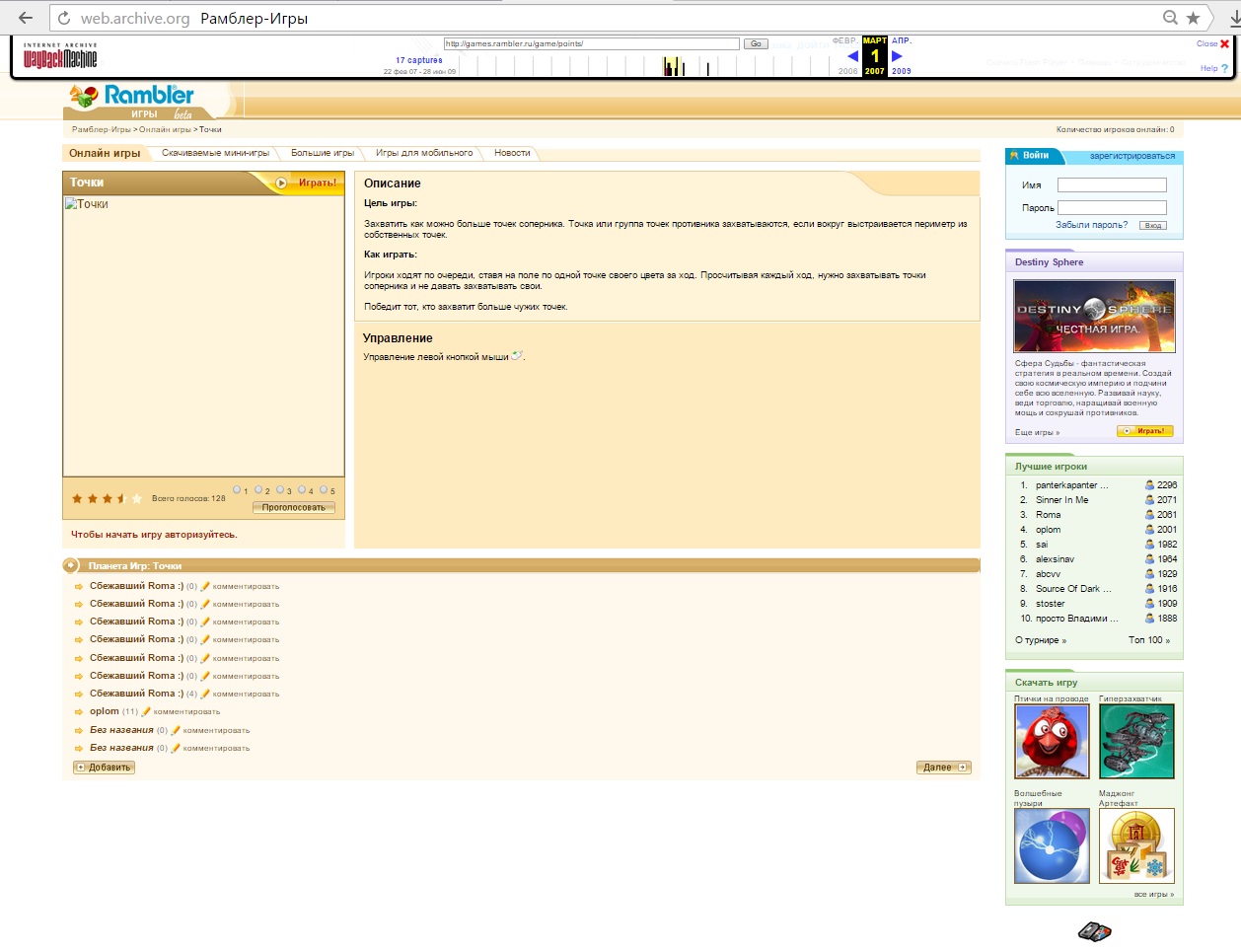
Dots wasn't left out of progress either. "Points XT" was still in good health when the first browser client appeared in the post-Soviet space. It was created as part of the Rambler Games service and officially launched on January 16, 2007. However, this project can't be called successful. Pavel Milov, whose website we've cited numerous times, once described this very well. We'll revisit him, as Milov was a firsthand witness to the events and played on Rambler himself. Here's how he describes his experience: "...despite the small field size (15x12), unstable operation, and cheating for the sake of positions in the leaderboard, a certain circle of fans began to form around the game in the first months of its existence... In the summer and fall of the same year (2007 - author's note), noticeable improvements in the quality of the game occurred: the field became larger (33x18), a central area for the first moves was introduced, closed encirclements that did not contain dots were no longer "painted over". Highlighting of the last dot placed, although not ideal, was implemented, and a time limit was made mandatory for ranked games. The number of disconnections with the game server decreased... The game also underwent minor cosmetic changes...: the choice of avatars upon entry and the calculation of the area of encircled territories are now a thing of the past. However, despite the aforementioned series of positive changes, by the end of its first year, the game was still officially in testing and had not been added to the general game catalog, and therefore its traffic from portal visitors was low…"A comprehensive assessment, from which it is easy to see that, in terms of gameplay, the client was significantly inferior to Points XT, being, essentially, an anachronism from the "paper" era. This circumstance, along with technological imperfections and the service administration's apparently frivolous attitude toward the project, prevented it from gaining a sufficient audience, as a result of which Dots did not last long on Rambler. The last mention of the client in the web archive is dated June 28, 2009.

Apparently, a little later than Rambler Games, points also appeared on the gaming portal. Livegames (Playset).At least on Milov's website, the first mention of this resource dates back to June 2008, although the portal itself was launched in 2006. Overall, Livegames has proven to be a fairly successful commercial project, which continues to thrive. As a collection of a huge number of diverse games, with numerous features related to communication and status, it has always enjoyed high traffic and, consequently, a constant influx of new players. Some of this initially benefited the Dots themselves. Among the undeniable advantages of the client are also reliability and high-quality technical support. Nevertheless, despite the ideal starting conditions, the Dots on Livegames did not, and by and large, could not, replace or even become an equivalent alternative to Points XT. This was hindered by the portal's very philosophy, which was essentially one large online casino. A flashy design, an abundance of graphic and functional elements designed to create the atmosphere of a respectable gambling establishment, virtual currency, "tables," and bets on every game. A rather arbitrary rating system, saying little about actual skill and focused primarily on gaming activity. All this was ideal for card games, but clearly contradicted the spirit of the Dots. Moreover, the functionality of the Dots client was always very limited and practically stagnant. A single game mode (no territory, minimal encircling area, no landing, single cross in the center of the board), a minimal selection of settings (three board size options and several time reserve options), no ability to review past games, and poor visualization of the board and dots.
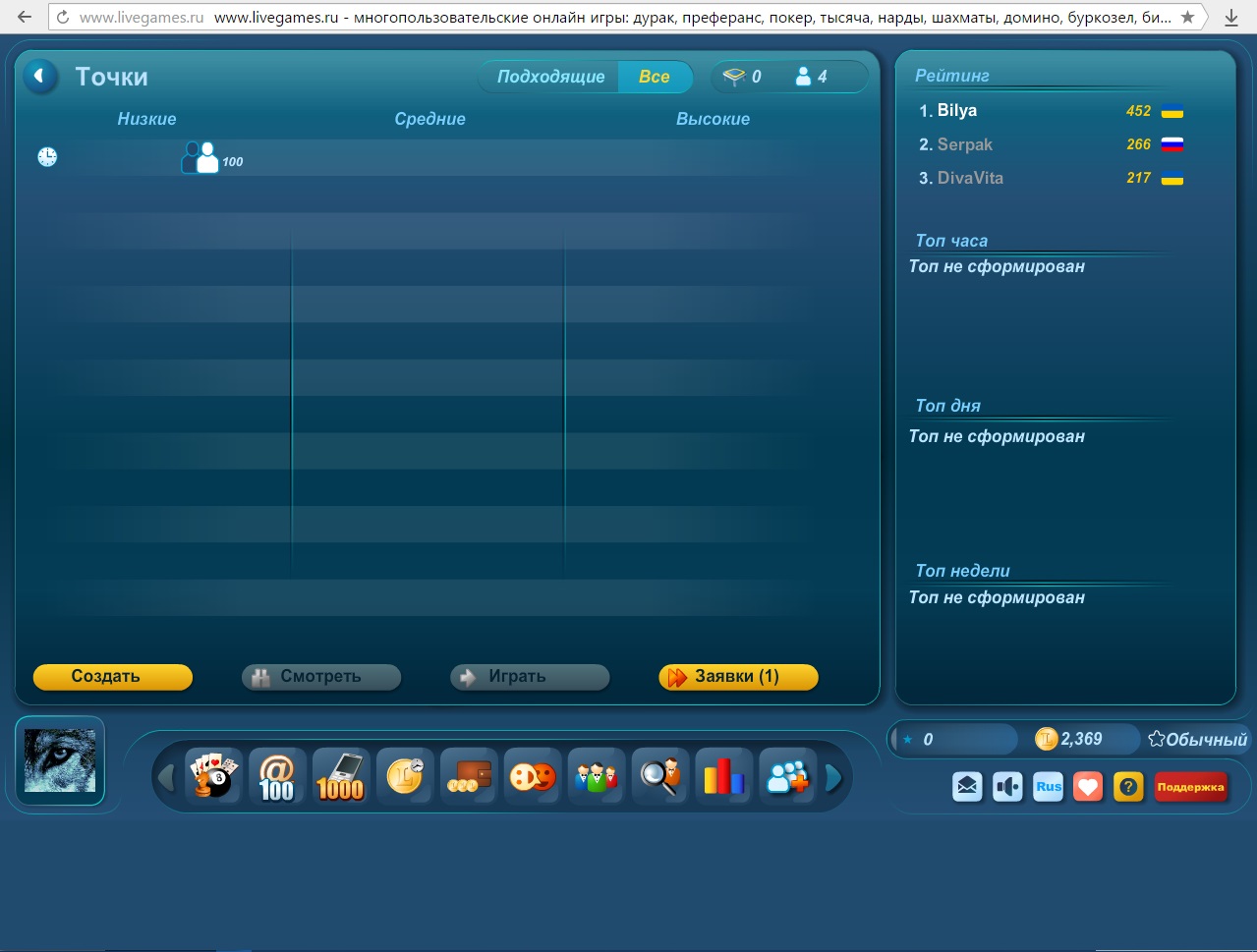
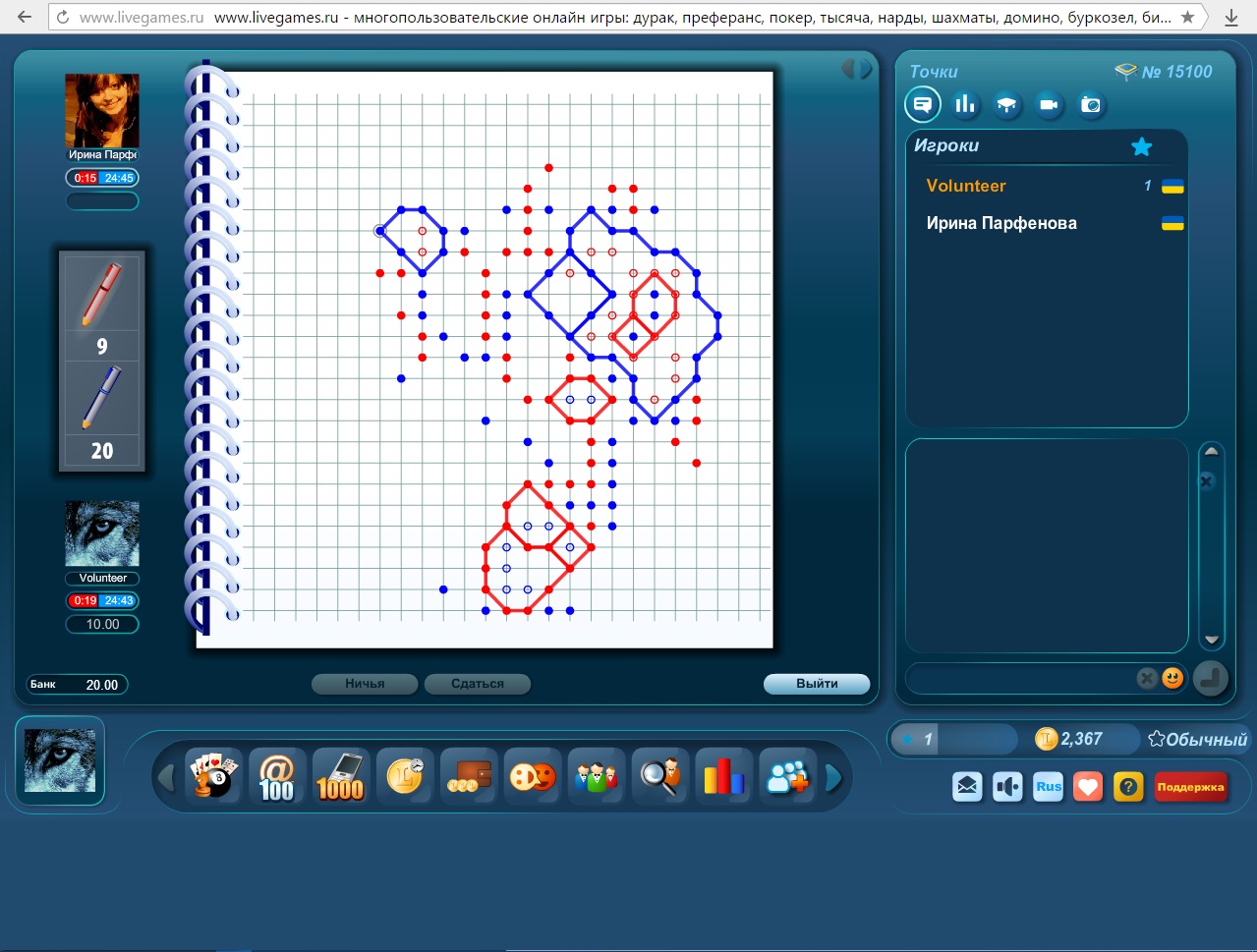
The Livegames client never became the arena for Dots tournaments; it was unpopular with the strongest players, and regulars seeking improvement sooner or later migrated to other platforms. A signature style of play, unwelcome anywhere but Livegames, became a byword. This style was known as "housebreakers." The lack of landing and small boards meant that players, after a drawn opening, resorted to the monotonous construction of traps—houses. As the board filled, a situation arose that forced them to place dots in these traps and, consequently, lose scores. The winner was the one who built the most houses.
Naturally, this state of affairs inevitably impacted the number of players. Their numbers dwindled each year, and demand for the client is currently close to zero. Perhaps the only positive contribution this platform has made to the growth of Dots is that one of the best players in history began his career on Livegames: Sergei Chernobrovin aka zed.
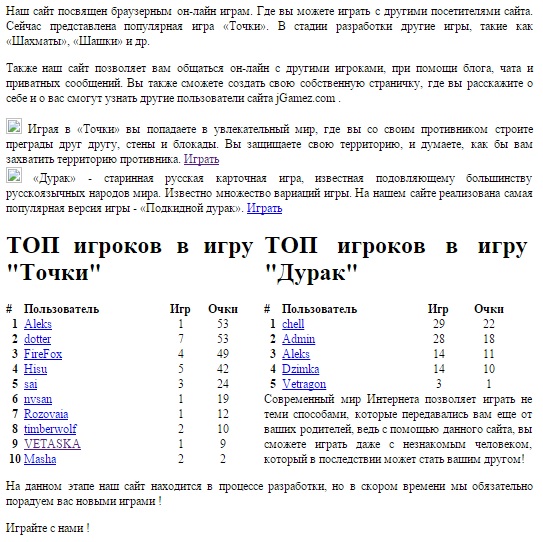
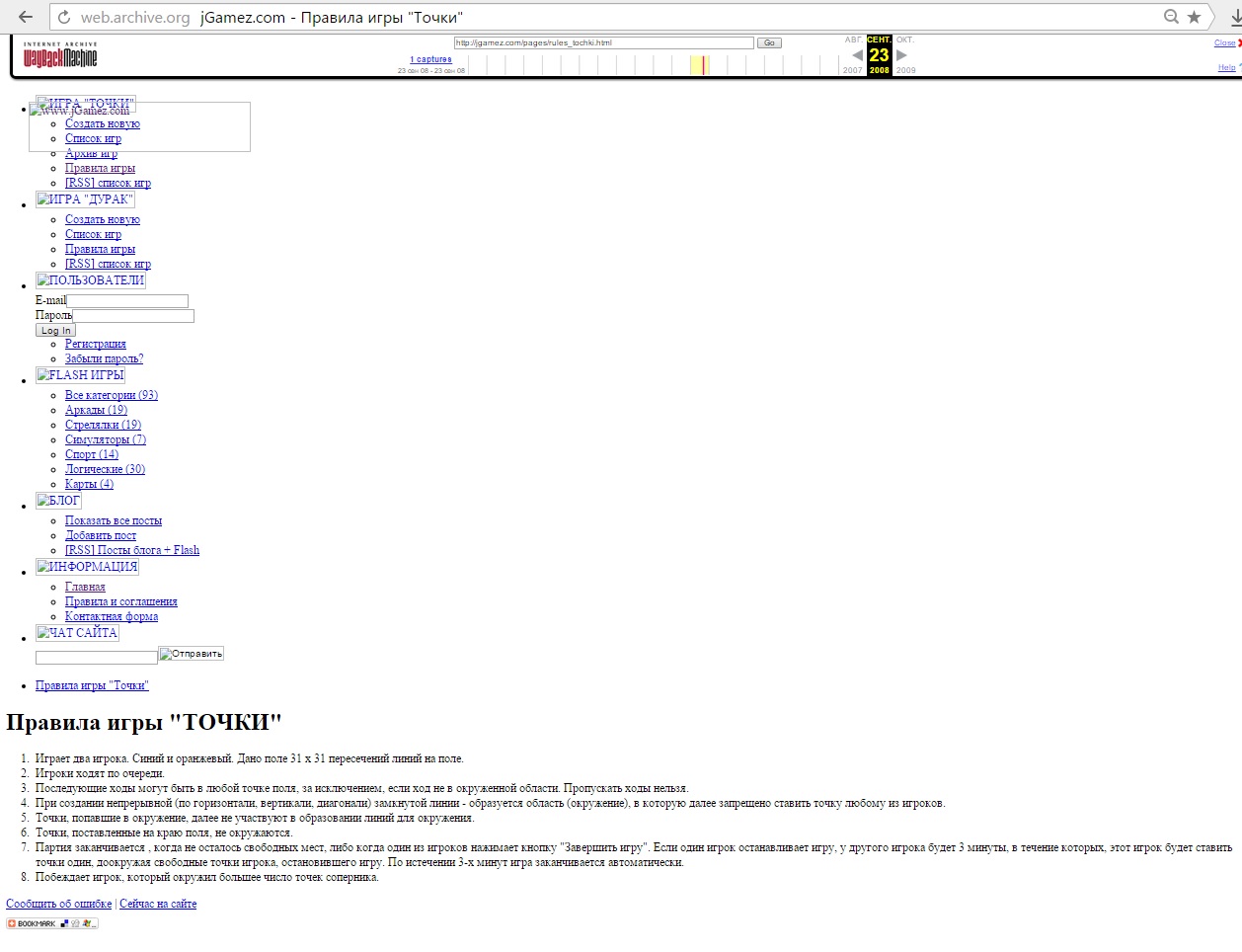
Attempts to use Dots to attract users to newly created web clients were also made during that period by much more modest developers. For example, in the summer of 2008, the gaming portal jGamezappeared online. The project's creators announced their intention to create a collection of various games on their platform, including Dots. The developer's technical and marketing capabilities, as far as can be judged from the fragmentary information preserved by the web archive, were quite modest. In this regard, jGamez resembled the purely amateur programs created by enthusiasts in the early 2000s. The client's functionality was very limited: a single field size (31 by 31), no cross, and unlimited time. Houses could be painted over, but there was the option to end a game early by landing. The number of visitors proved negligible, so the portal's development soon ceased: after September 2008, there are no mentions of jGamez in the web archive.

Well, the audience question has always been key. It's hard to attract and even harder to retain. While the natural evolution of network technologies might have suggested the right solution in the first case, in the second, everything depended on the quality of the product and its constant improvement. In late 2008, these two elements converged. And—it took off.
 The social network VKontakte which was then gaining momentum, announced a competition for developers of apps based on its API. One of the participants was Artem Kolnogorov, aka KoLar,who proposed a client, or the game of Dots, which later became famous as VKontakte Dots.The first version of the client was launched in late June 2008, as evidenced by the earliest post in the app's dedicated group. Initially, it was very simple, if not primitive. However, basic features such as the style of interface elements, the design of the game board, and the encirclement algorithm proved to be remarkably successful and progressive. Thanks to this, as well as the significant interest from social network users that emerged almost immediately, the client was actively developed and improved.
Updates were regular throughout the first year. Acceptable reliability was achieved, a rating system, game time, statistics, and a game archive were added, the range of settings was expanded, and communication and learning capabilities were improved. Vitaly Kolosov also made a significant contribution to the project's development, particularly in terms of gameplay and sports activities. He joined the project a few months after the app's launch, intrigued by the new feature and offering his assistance to Kolnogorov. The experience accumulated over the years of Points XT proved invaluable, allowing VKontakte Dots to become the most advanced gaming platform at the time. At the same time, Kolnogorov didn't blindly copy its predecessors: the app retained its unique style and distinctive architecture.
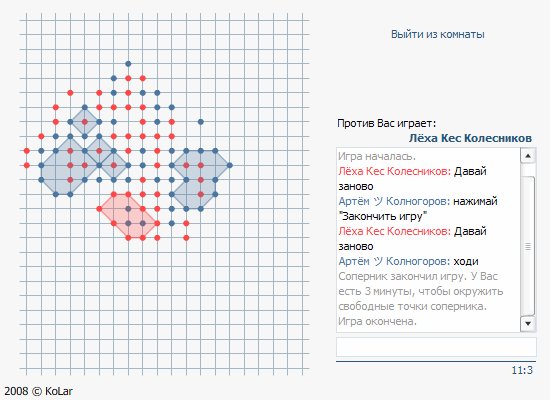
In February 2009, the client was updated to version 3.0, which reached its final version in June of that year. With a few minor tweaks, it remains in this state to this day.
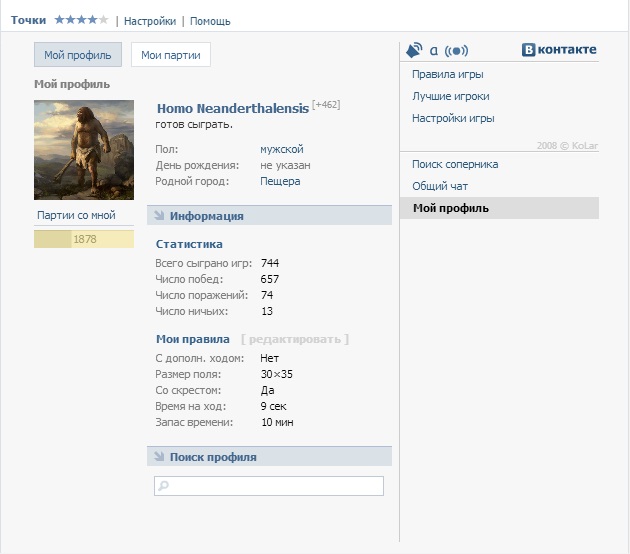
VKontakte Dots are distinguished by a distinctive minimalist design, consistent with the social network's overall style, and a simple and user-friendly interface. Each player has his own profile with statistics and a game archive and can view the profiles of other users. Game invitations are sent using the player list on the main page (previously, it was divided into several rooms: a game room, a "sandbox" for beginners, and a tournament room, but this division is no longer present). Games are always played according to the settings of the person being invited.
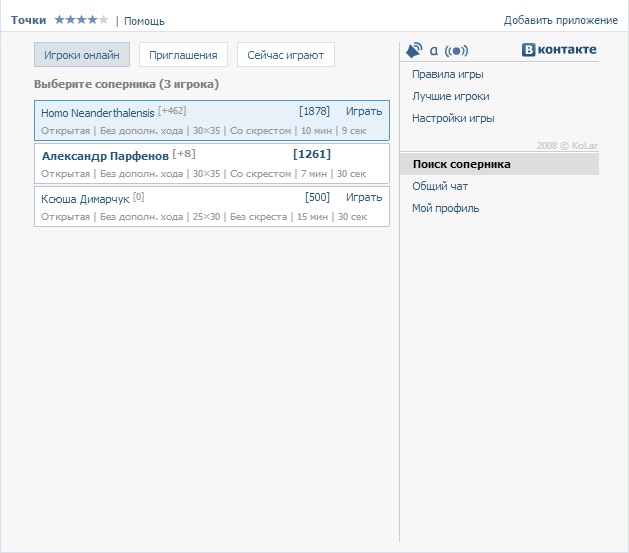
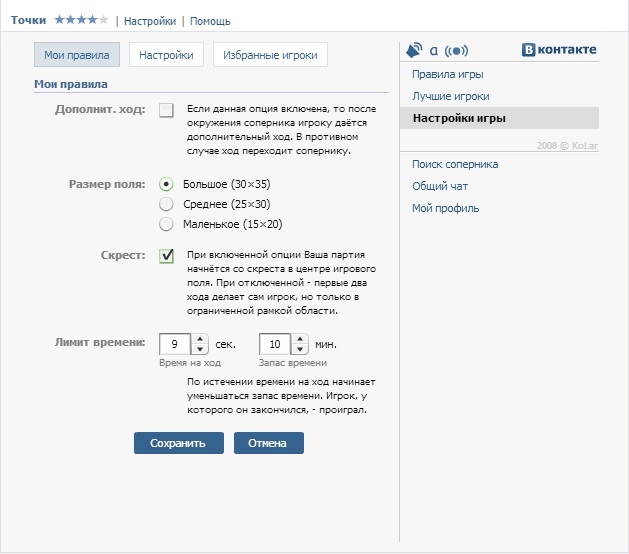
The game rules are modern: no territory, landing, and minimal encirclement area. The choice of openings is limited to an empty board (with a starting area) and a single cross in the center. An option to activate a game mode with an extra move is available. The boards are rectangular, vertically oriented, and come in three standard sizes, excluding the classic "notebook" size. The timer includes a renewable time per move in seconds and a permanently expendable time in minutes. A pause can be requested. There is no blitz with a random dot or undo. The size and appearance of the points, as well as the board design, remain unchanged. Sounds accompany the game challenge, the next move, and personal messages.

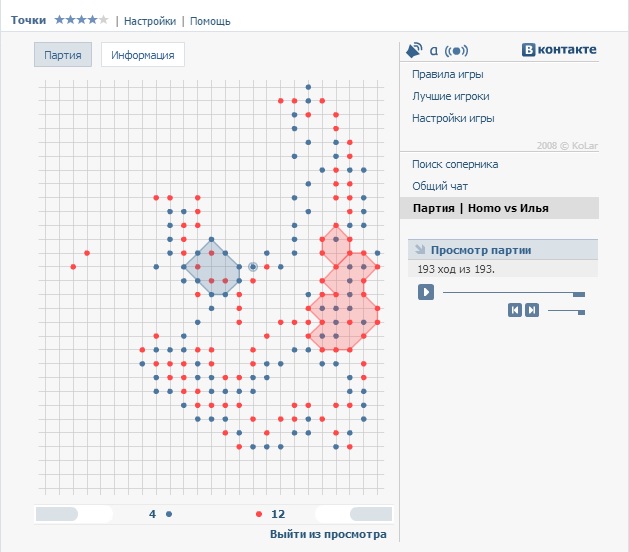

The rating system is based on ELO. Games can be either rated or unrated. Players also have a "reputation," which is determined by the ratings they give each other after each game. There is no full rating list; only the top players are displayed. Current games can be watched as a spectator, but users can choose to hide their games from prying eyes. A player with a scroll bar is available for viewing archived games. Communication is via general, in-game (with the option to block spectators), and private chats. Features include a blacklist, a "favorite" player selection, a rating filter for opponents, and a stealth mode.
Of course, VKontakte Dots can't be called an ideal client. Not now, obviously, not even in its best times. The focus on maximum simplicity, perfectly logical for a purely amateur project, had a downside, which ultimately played a significant role in its fate. While visual flaws, such as the insufficiently large playing field, small and rather faded dots, and the lack of ability to correct these issues through visual settings, weren't particularly significant, serious functional issues stemming from the initial technical decisions ultimately proved fatal. The application didn't have its own server; important information was stored by the social network, and player moves were transmitted via private messaging. While this was simple and advantageous, it only worked properly under minimal load and required constant monitoring by its creator. As long as online traffic was low and Kolnogorov had the time and patience to promptly respond to complaints and resolve issues, the client more or less managed. When the author moved on to other projects and the number of players grew significantly, the inherent defects became apparent and made playing the app a rather dubious pleasure.
 At first, however, all went well. By mid-2009, the app had been installed by tens of thousands of people, and the number of casual online users steadily increased, peaking at over a hundred. The symbiosis of the game client and the social network ensured a constant influx of new users, and although most didn't stay long, even those who did were enough to maintain gaming and, just as importantly, social activity. It was almost always possible to find an opponent in the app, and thanks to the convenient chats within the client and the social network group, the most engaged audience had unlimited opportunities for live communication, which they enjoyed. A large and devoted community quickly formed around the project. People began visiting the app out of habit, not so much to play as to enjoy themselves in good company. Interest groups naturally emerged: players made friends, feuded, flirted, schemed, fell in love, gossiped, argued, and created, managing to play Dots in between these exciting activities. Interconnected projects were created spontaneously, such as the Dots Oscar —an annual awards show with numerous nominations. Life was in full swing, and many players still remember the unique atmosphere of those times with nostalgia.
 The phenomenon of "cloning" also deserves mention. It was on the Kolnogorsk app that it became widespread, becoming an integral part of the project's identity. Clones are social media accounts with fictitious names that users created to play incognito. Typically, this was the dabbling of relatively strong players who wanted to re-establish a high rating while maintaining good statistics. Over time, there were so many clones that discussing them became a favorite pastime among the app's regulars: some expressed outrage, others performed feats of deduction trying to determine the true owner of the latest duplicate, and still others simply had fun. Quite often, the holders of pseudonyms held self-exposure sessions. For some players, clones became their primary profiles and a kind of calling card, and individual fictional characters eventually became legends, such as Homo Sapiens Neanderthalensis, the most famous clone of VKontakte Dots (incidentally, more than one person played under it, but it's probably not worth revealing). From a sports perspective, cloning was more of a problem, which was generally acknowledged by the community. However, from a social perspective, the negative perception of this phenomenon is less obvious, as it nevertheless fueled interest in the game and communication to some extent.
 It wasn't just pleasant conversations, however. Progress in gaming was also evident. The average skill level, initially quite low, was improving at a good pace. Many players, many games, many opportunities to learn from the mistakes of others and their own—all of this set VKontakte Dots apart from other platforms. Of course, the Points XT alumni also made a certain contribution to the project's sporting development, but it couldn't be called decisive or even significant. They played, yes. Some for fun, some for the top spots in the rankings or prizes in tournaments, some to promote the only true Dots teaching. However, they played little and were clearly unsuited to the role of teachers. At best, they were examiners. At the same time, they often made no secret of their arrogant attitude toward the new platform, which, of course, provoked reciprocal hostility. Therefore, the community's gaming development largely followed its own path. Through trial and error, hundreds of games, and thousands of losses, the regulars of VKontakte Dots slowly but surely accumulated experience and developed a distinctive playing style. If I had to describe it in one word, "pragmatic" would probably be the best. Unlike Points XT, where a tight, double-edged game was considered good form, the Kolnogorov's app's alumni generally preferred to play cautiously, building strong branches early on. This allowed them to survive in a highly competitive environment and also to mitigate the difference in skill with the rare missionaries of the "Black Order." The number of quality players grew with each passing month, and their own stars began to shine with increasing frequency. The best of the "crusaders" maintained a slight edge in skill for a while, but in terms of the number of strong, tenacious mid-table players, the iconic arena was hopelessly outmatched. The laws of philosophy, as we know, are inexorable: quantity inevitably leads to quality sooner or later.
Around the second half of 2009, a kind of reverse colonization began. The strongest and most ambitious alumni of VKontakte Dots began frequenting Points XT, enlivening the sleepy world of luminaries resting on their laurels and adding their names to the dusty tablets. The difference was that they went to someone else's monastery to learn and develop, rather than preach their own rules. This approach was the only correct one and quickly yielded excellent results. Hardening on VKontakte and polishing on Points gave Dots a whole generation of brilliant players, many of whom went on to become prize winners and champions of various tournaments. The best of them, Alexey Priymak, aka alf, can rightfully be considered one of the strongest players in history.
 It's a shame, but this fairy tale didn't have a happy ending. In the fall of 2009, when the project was booming in terms of gameplay and social development, the app's technical inadequacy to cope with the increased workload and increased demands on its reliability became fully apparent. The client couldn't handle the processing and transmission of moves, games froze, player dots changed color, and encirclements changed configurations. A barrage of complaints went unanswered: Kolnogorov, for whom working on the app had previously been something of a hobby or a way to expand his personal portfolio, had completely switched to other projects. For a long time, players couldn't believe that their cozy little world was doomed. It took several months of torment, accompanied by streams of angry and despairing messages in the group, for the most devoted community members to give up and accept the inevitable. The final straw that broke the camel's back were the rating resets, which first occurred at the end of 2009 and became regular in the second half of 2010. Belated attempts to mitigate the problems, such as Kolnogorov granting Vasily Novikov limited administrative rights, were unsuccessful. Novikov couldn't fundamentally change anything, and manually fixing the consequences of the constant crashes was a chore. The agony began. The app itself, of course, was still there, but only rare newcomers and those eager to make it onto the top lists, which, of course, quickly deteriorated, dared to play. This fuss, slowly fading, continued for another couple of years, after which VKontakte Dots finally became an artifact.
The community, its core removed, quickly dissolved. The most motivated players found refuge on Points XT, some went into a holding pattern for new projects, but the bulk of the community—that golden mean—was lost to Dots, largely forever. For the game's development, this wasn't even a step—it was a leap backwards. Dots once again became isolated within a small group of enthusiasts who had neither the resources to rectify the situation nor a clear understanding of how to do so. Kolosov's withdrawal, apparently unwilling to return to amateurism, didn't inspire optimism either. The organizing force was gone, and with it, an entire era in Dots' history. A timeless era had arrived.
 Meanwhile, the memory of the most successful Dots project lived on, and the dream of its revival hung in the air. So it's no surprise that an attempt to tap into the audience's nostalgia was made. On September 15, 2012, visitors to the new Dots portal were given a glimpse into the past: the game client, launched that day, turned out to be a near-exact copy of Kolnogorov's app. The creator of the project, known as to4ki.ru,was Dmitry Telny, aka Morpheus.It was arguably the first purely commercial venture in the history of post-Soviet Dots: the actual work was handled by outside specialists, while Telny acted more as a producer, demonstrating a serious, comprehensive approach.
Extensive and fairly high-quality content was prepared for the portal. Firstly, there was theoretical material, summarizing and systematizing Telny's gaming experience as a textbook. Secondly, there were interviews with renowned players from different generations. The site's main highlight, without a doubt, was the game archive. Essentially a collection of antiques, it consists of a list of a large number of games and a player for viewing them. There are games played on Points XT, a selection of battles from four tournaments, but the bulk of the content is comprised of games from VKontakte Dots. Kolnogorov donated these to Telny, who also allowed him to use the structure and design of his app.
There's no point in describing the client itself—it was virtually identical to the original. Internal authorization with nicknames, dividing the player list into multiple rooms, and that's about it. Technically, of course, it was more advanced, as the lack of a social network connection and the presence of its own server ensured smooth operation, but the gaming and social features remained unchanged. A key feature of the project was that to4ki.ru, in conjunction with the web client, also promoted the Dots Online mobile app for iOS, released on May 3, 2012. It was an original product, primarily noteworthy for its design, styled after classic "paper" Dots.
To be fair, it's worth noting that this wasn't the first attempt at creating a Dots client for mobile devices. On January 30, 2011, Andrey Vyzhva, aka Mustanger, published information about his program, Points Logical Mobile Game.It was available for all phones and PDAs that supported MIDP 2.0 and allowed connection to an IRC server to view Points XT games. This project never left the testing phase, and the scant information about it is currently available only in the web archive.
But let's return to to4ki.ru. As we can see, considerable effort and resources were invested in this project. And it certainly generated some interest among long-timers. However, this interest never matched the popularity of VKontakte Dots and quickly faded away. Why? There are several reasons. First, the project was simply too late. More than two years passed, the old community had disintegrated, and even a handful of die-hard enthusiasts were long ago playing on a new platform, compared to which the copy of Kolnogorov's app offered absolutely no functional advantages. Second, to4ki.ru, being an isolated client, couldn't count on the massive influx of newcomers that the social network had previously provided. Finally, the "nostalgic" approach didn't work. People weren't pining for a bunch of pixels on a screen, but for the unique atmosphere of live communication, which was impossible to replicate. The project was unable to create its own community, since it had almost no social functionality.
It's not as if Telny's work was in vain. The portal, which continues to operate today, made a significant contribution to the popularity of Dots. While the client was operational, it wasn't entirely empty. A small group of regulars formed, and strong players from outside the network occasionally dropped in. Perhaps to4ki.ru could have nurtured its own stars—Livegames succeeded in doing just that with Chernobrovin—but the invisible hand of the market did its dirty work. The project's concept failed; it proved unprofitable, and it apparently couldn't remain perpetually confined to the personal computer of a devoted fan, like Points XT. On December 18, 2014, the game server was shut down, and the client page featured a call to play the VKontakte Dots. It's hard to say what the author actually intended, but from the outside, it looked like a cruel irony.

The circle is complete.
Alexander Parfenov
First published April 21, 2016
Part One | Part two | Part three | Part five