
Thus, throughout the 1980s and 1990s, Dots firmly occupied the niche of a beloved intellectual competition among schoolchildren and students, with no competitors in their class and no prospects for further development. However, at the turn of the millennium, the situation changed dramatically. The personal computer was no longer a luxury, programming was no longer the preserve of a few professionals, and the World Wide Web was no longer a foreign curiosity. The rapid growth of information technology created a new reality, which contained both potential opportunities and obvious risks. On the one hand, Dots had the opportunity to emerge from their closed world, expand their audience, and begin moving toward sporting and commercial viability; on the other, they very quickly lost their monopoly in the field of youth entertainment. The near-vertical rise of the gaming industry and the widespread adoption of compact digital devices increased competition by orders of magnitude, changed audience preferences, and quickly relegated the classic paper Dots to the status of anachronism. To avoid fading into oblivion, the game needed to quickly embrace the digital format.
And it all started off quite briskly. By the early 2000s, the first generation of engineering students had grown up for whom programming was their primary occupation or serious passion. Dots seemed like an ideal outlet for their creative efforts: the game was familiar to the pioneers, and the simple rules and minimal visual requirements made implementing a computer model an easy task. An additional incentive was the desire to create artificial intelligence that could mount a viable challenge against humans.
Although not much time has passed since then, reconstructing a detailed chronology of events and describing all these projects in detail is quite difficult. Very few active sources remain; typically, one must make do with copies of individual pages from web archives. The authors' contact information is outdated, and those who were found are unwilling to communicate. Nevertheless, this fragmentary information does provide a certain insight into the early years of computer Dots.
Before we begin, let's make an important disclaimer. Computer Dots developed not only in the post-Soviet space, but also in Poland and the Czech Republic. These processes occurred in parallel and largely independently, so for the sake of clarity, we'll consider the eastern and western directions separately. First, the East.
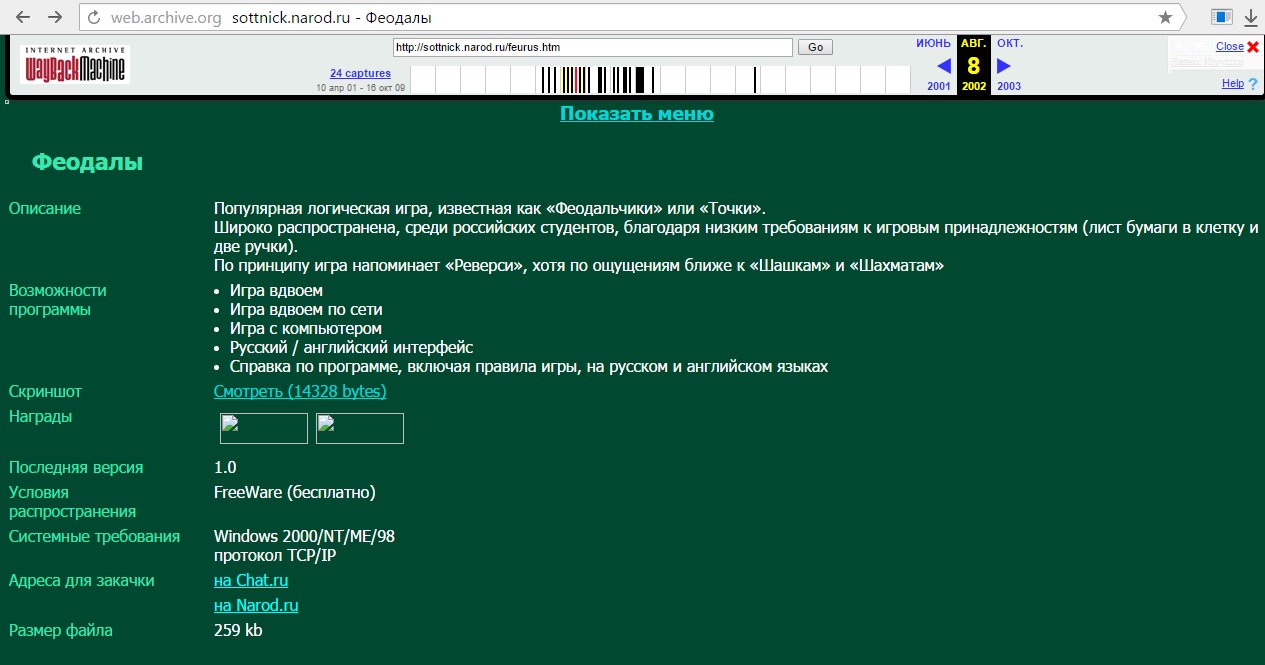
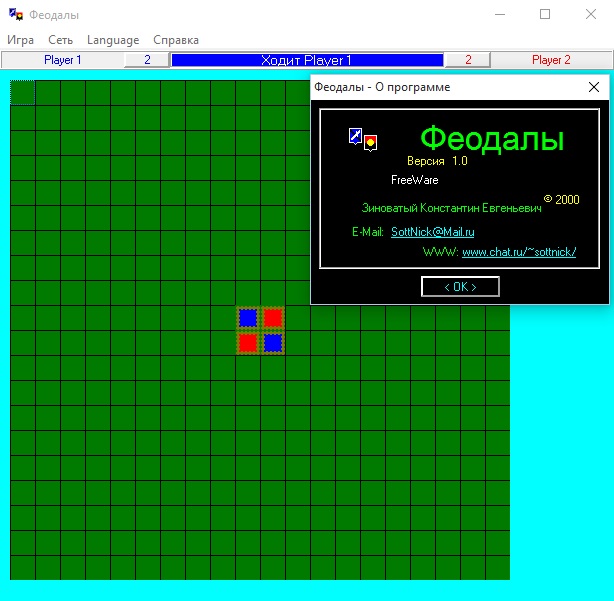
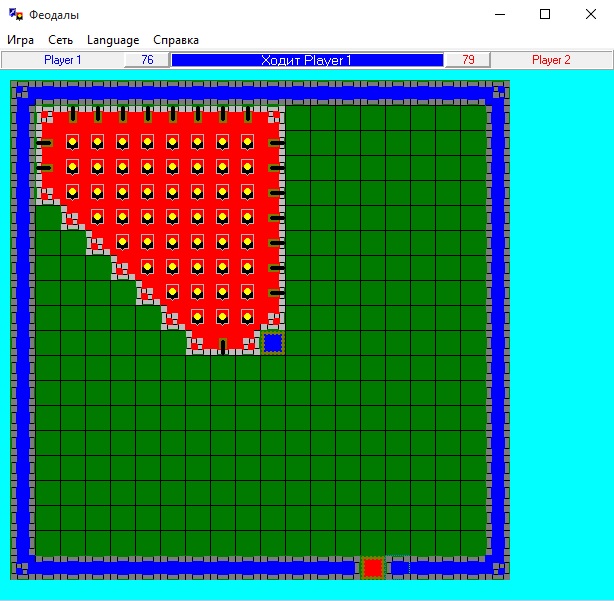
The first game (at least, nothing earlier could be found) was Feudal Lords by Konstantin Zinovaty,which appeared in 2000. It's a very interesting and unusual project. Actually, this game isn't really a Dots game in the traditional sense. Apparently trying to attract an audience with the style of the cult Heroes of Might & Magic, the author depicted the confrontation using square stone blocks that, when connected, created structures reminiscent of fortress walls. However, the algorithm for constructing these "walls," as well as capturing the opponent's "castles," was entirely consistent with the rules of Dots game, with the exception that the blocks occupied squares rather than intersections of lines. Surprisingly, it was in this program that we first see the prototype of the future starting cross. The houses in Feudal Lords weren't painted over, but encirclement was accomplished along the maximum trajectory. Play time was unlimited, and the game ended when the entire board was filled. It was possible to play with artificial intelligence, although it was very weak. The program was released in a single version, with no information about its audience. This "medieval" setting was never developed further. The client can still be downloaded from the web archive.

t's difficult to determine the next project in terms of its origins. A study of sources reveals an interesting pattern: several programs appeared almost simultaneously in 2002. It seems as if the creators were inspired by the same important event. It's doubtful that "Feudal Lords" could have served as a model: the style of the new programs is completely different, and a considerable amount of time has passed. In our opinion, the most likely candidate for the inspiration is Pavel Torgashov.
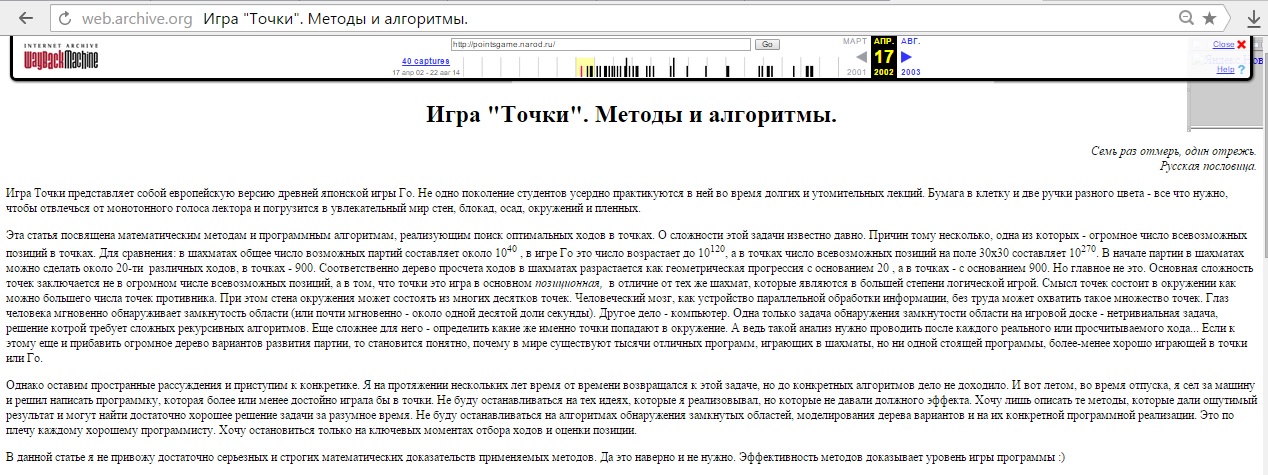
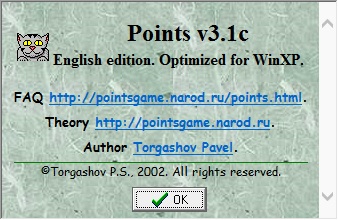
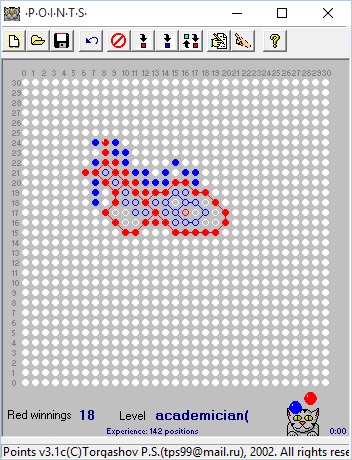
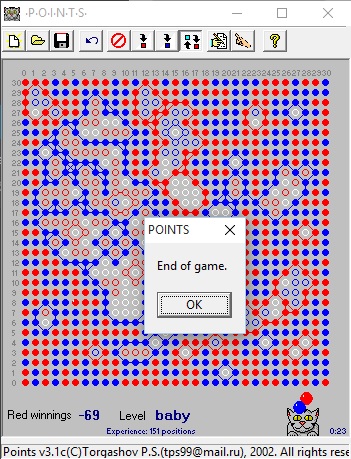
In early 2002, he published his article "The Dots Game: Methods and Algorithms"online. This was a fairly substantial work, in which the author mathematically substantiated the methods he used to create the artificial intelligence for his Dots-based program. The article made a significant contribution to the development of this field; some of the methods described by Torgashov (such as the pruning of variants) were later used in other projects. At the time of its publication, it was the only study of its kind, which could well have sparked increased interest in creating programs for the Dots game. The first saved copy of the page where the article was published is dated April 17th. However, in the preamble, Torgashov writes that he began work on the project "in the summer, during vacation."Clearly, this could have happened no later than mid-2001. Apparently, around this time, he began developing the client portion of his program, called PointsIt allowed play via a remote server, as well as with artificial intelligence, which had several skill levels. Its functionality was quite rich for its time, but its graphics were questionable. The game board consisted of a gray background with round white slots into which dots were placed. The rules were quite "paper-like": the encirclement was controlled along the maximum trajectory, the houses were painted over, there was no time limit per move, and the game continued until all the points were filled. The program was updated several times, and the remote server functioned until at least the end of 2004. According to experienced players, it enjoyed some popularity, but eventually lost out to competition from PointsXT.The client is still available on the author's page.
Several programs created around the same time or slightly later than Torgashov's "Points" have survived only as copies of the pages they were once hosted on. The clients themselves are unavailable, and it's impossible to say anything specific about them.
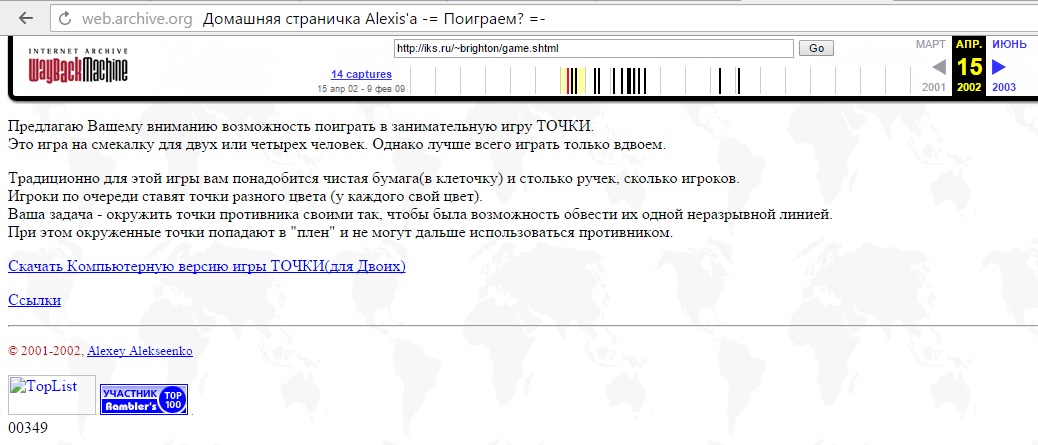
Alexey Alexeenko's TOCHKI, the first mention of which in the web archive dates back to April 15, 2002. The only thing known about the program is what Mikhail Petrov, the creator of another client, later wrote about it. According to him, it allowed playing locally or via a remote server, and had no artificial intelligence.
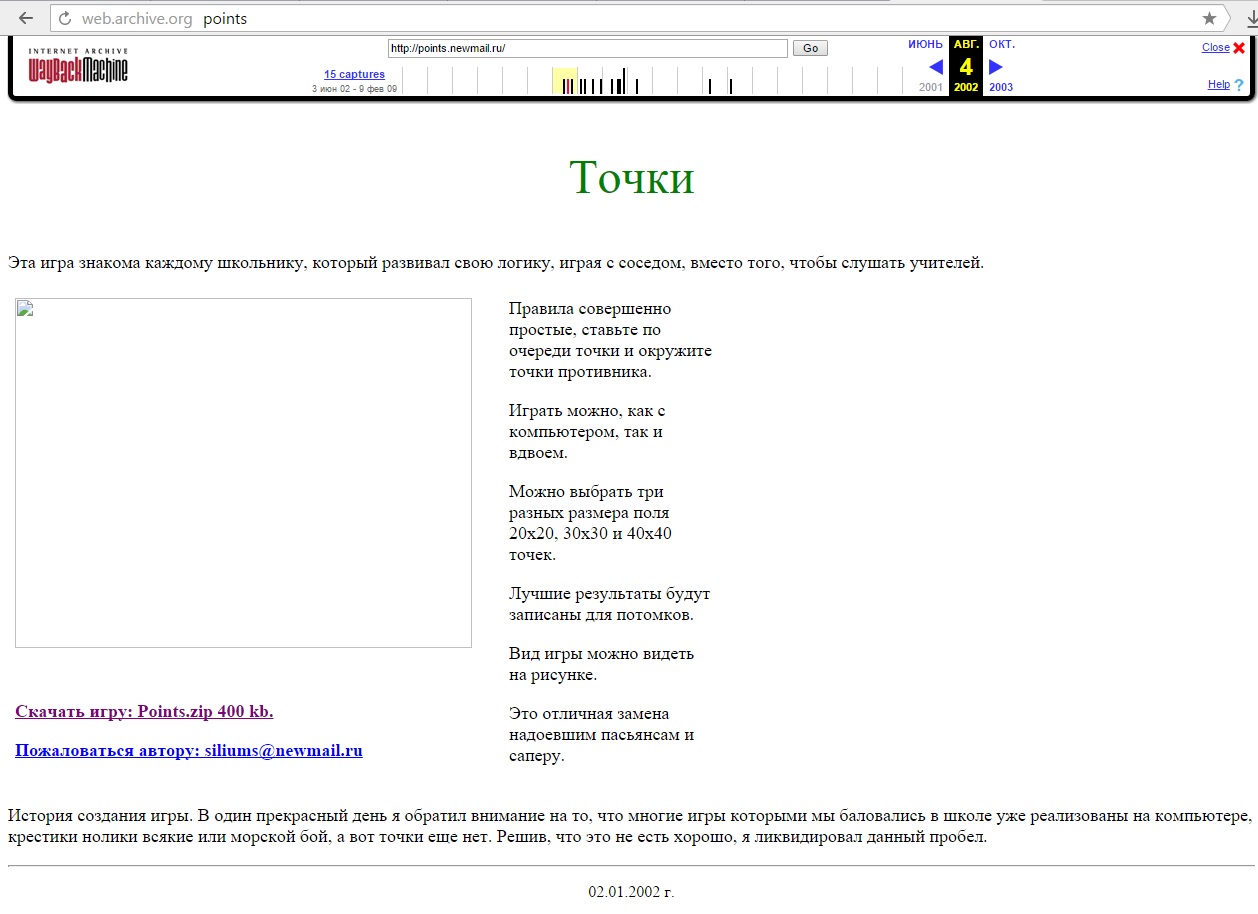
Points by an unknown author, now known only by the nickname Silimus.The program's creator dated his page to January 2, 2002, but the first copy appeared in the web archive only on June 3. Judging by the description, the client allowed local play or against artificial intelligence. Furthermore, the board size could be adjusted.
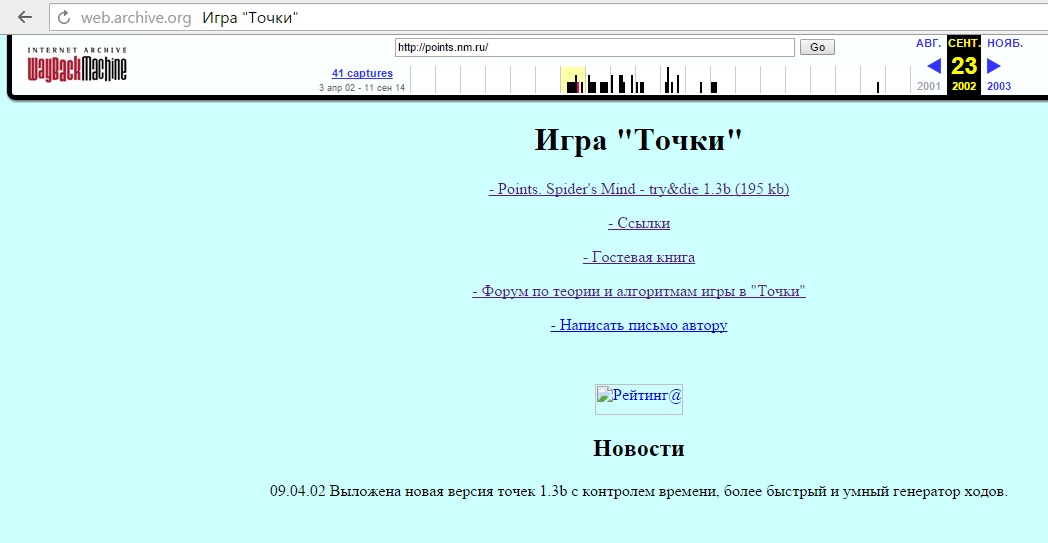
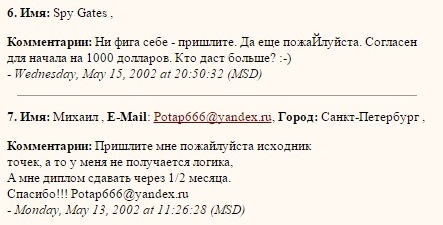
Spider's Mind was created by an author known only by the nickname Spy Gates.Both the creator and the web archive date the program's appearance to early April 2002. Judging by the description and Petrov's testimony, it allowed for local play and against artificial intelligence. While researching Spider's Mind, an interesting observation was made that helps better understand how similar programs were created back then. The web archive has preserved a copy of the guestbook page, where one user asks the author to share source code needed for his thesis.
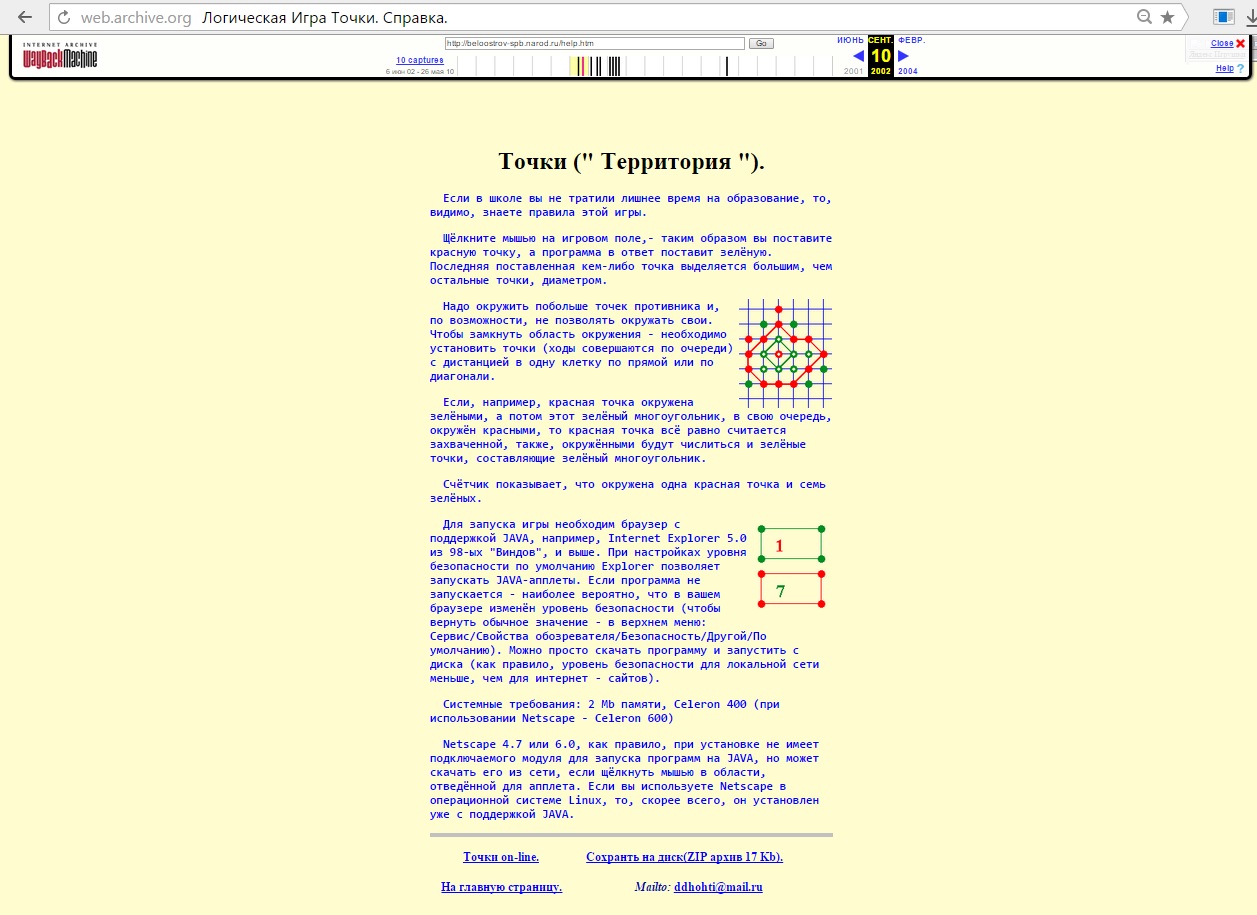
Territory by Dmitry Dvortsov.The program is interesting in that it could be played not only by downloading the client but also using a Java player. Furthermore, the scoring rules described on the page are unusual: if a player encircled an area previously encircled by an opponent, they would score the corresponding number of dots, but the opponent would not lose any scores they had previously earned. A copy of the page from a web archive, first saved in June 2002, contains a small illustration giving an idea of what the playing field looked like. Here we see the familiar grid, but the colors of the dots—red and green—are different from those commonly used today.
Dots by Andrey Yemelyanov.Individual pages of the websitewhere the program was hosted are still accessible, but the client is no longer available for download. The web archive dates the first copies to December 2002. No details have survived, only screenshots of the test and final versions. The appearance is the familiar grid of blue and red dots.
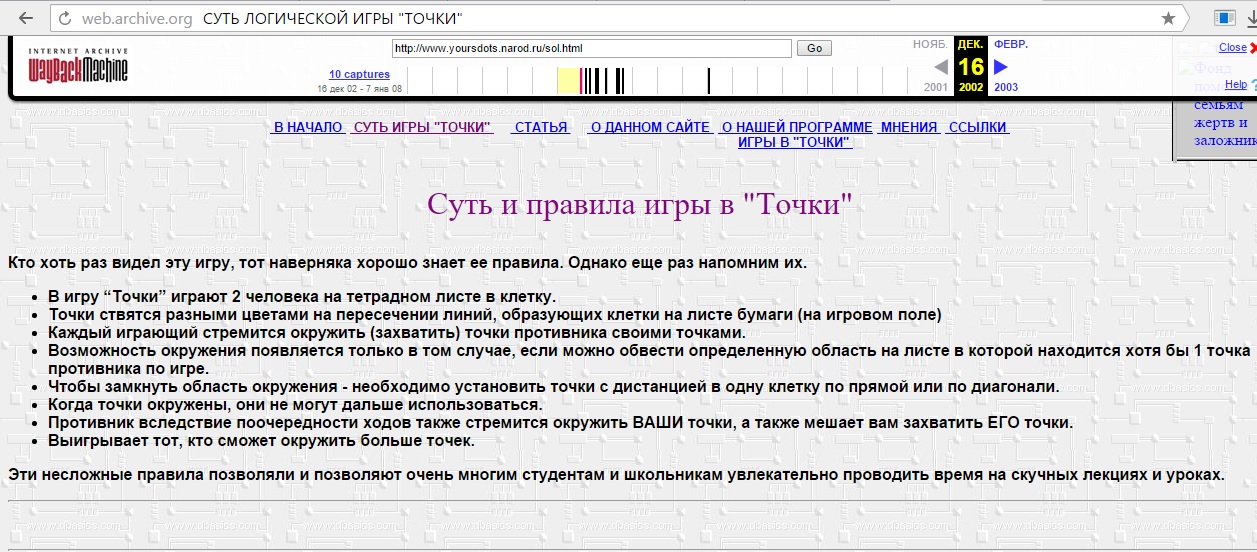
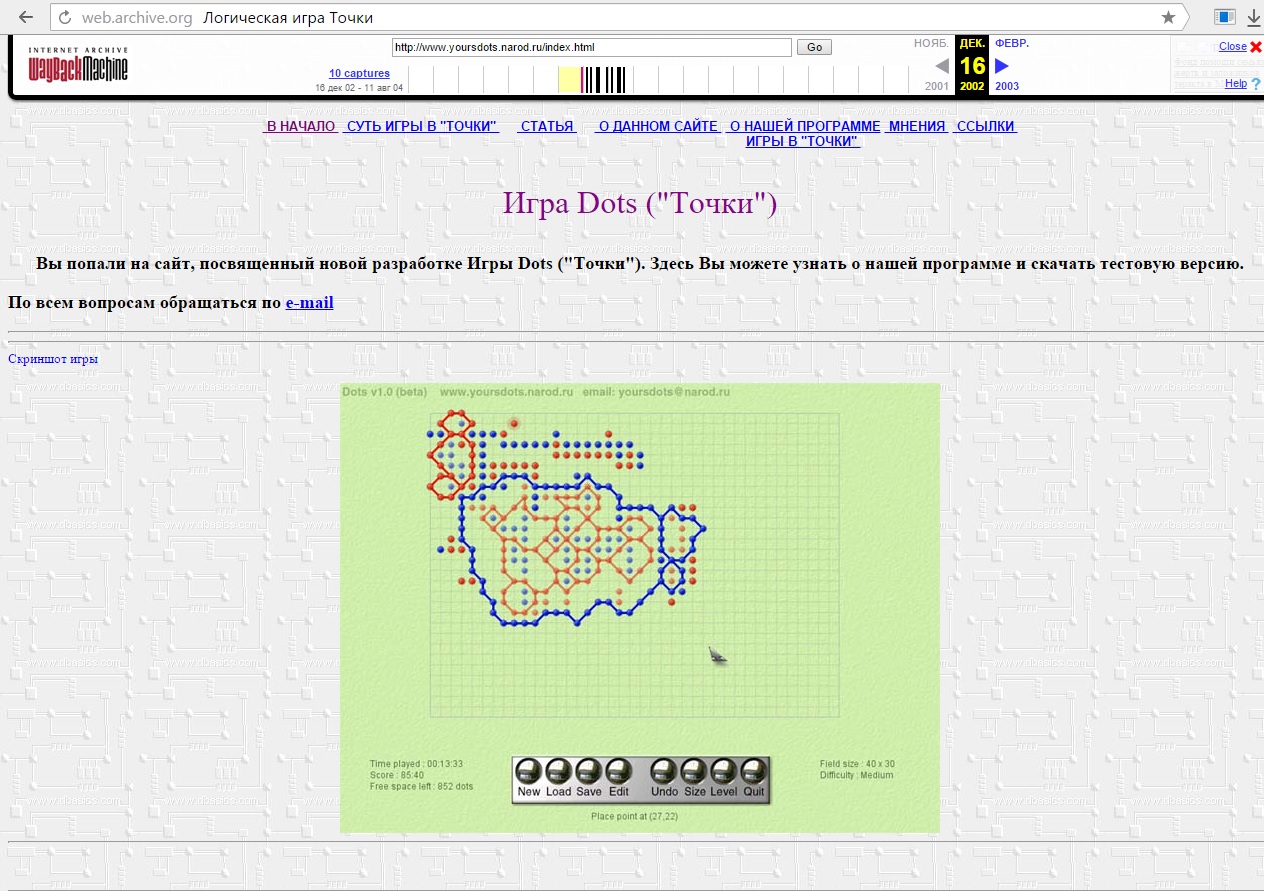

Vasily Surovtsev's Dots,created in 2003, remains only a brief description and a couple of screenshots of the client, which only allowed players to play with artificial intelligence.
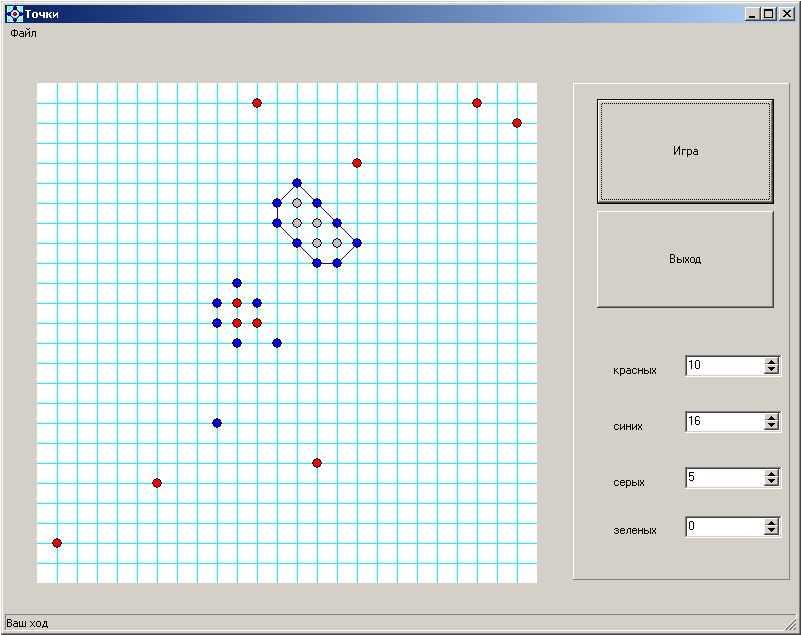
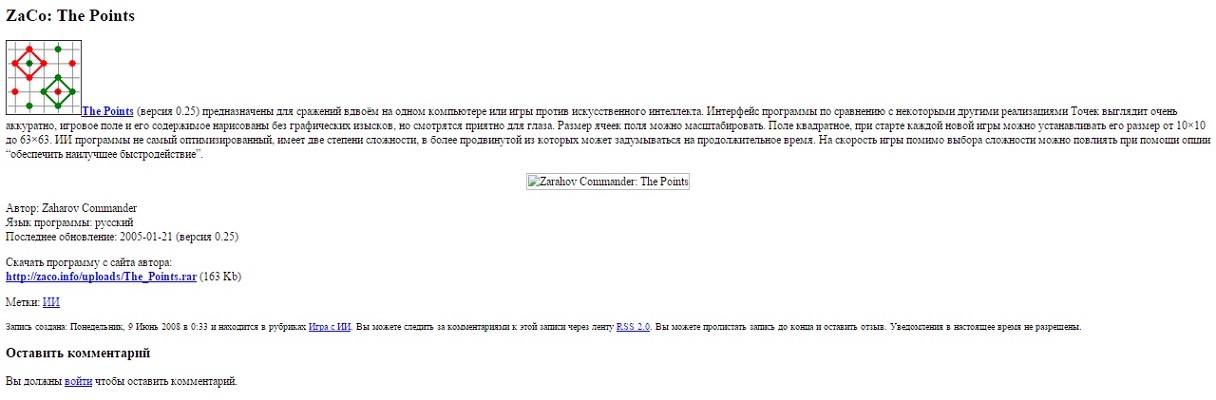
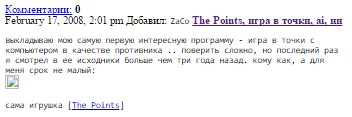
Finally, there's The Points,whose creator is known by the nickname ZaCo (apparently derived from the surname Zakharov).The client allowed players to play against themselves or against artificial intelligence. The last update was released on January 21, 2005, but development apparently began in 2004. The project is mentioned in the creator's blog and on Pavel Milov's website (both sources are only available in the web archive).
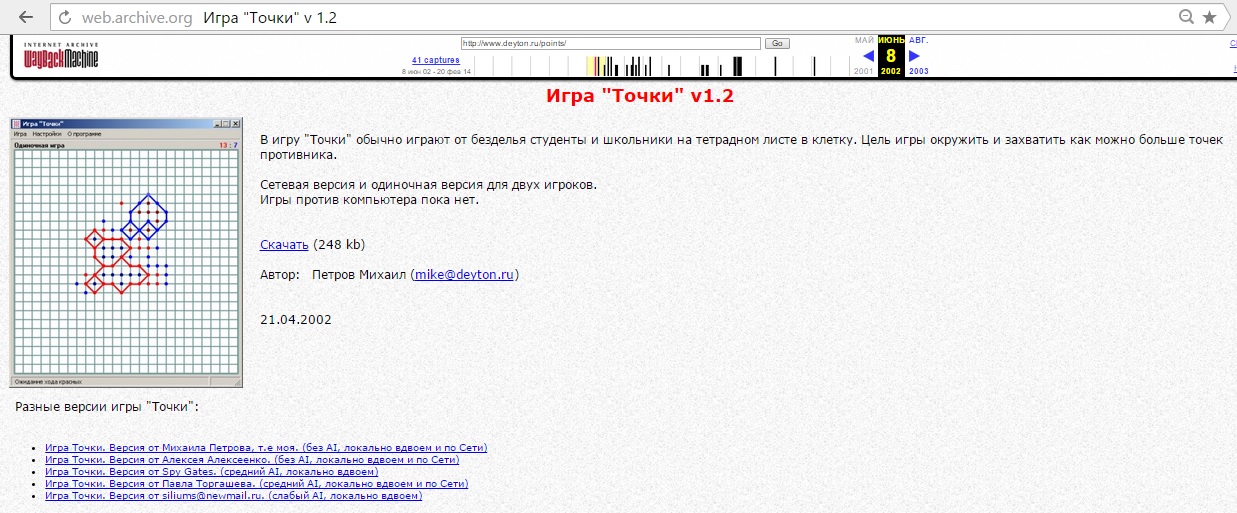
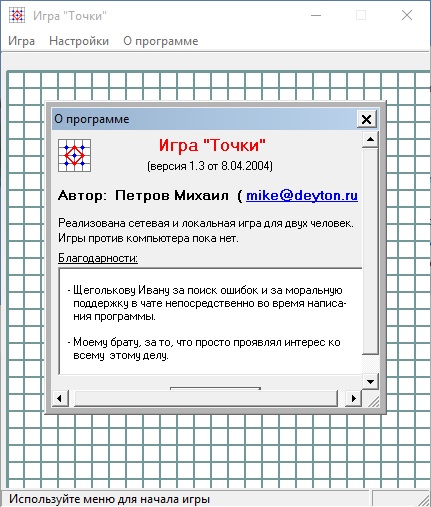
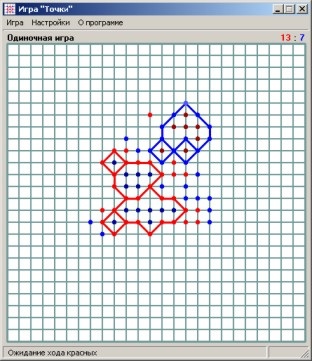
The work of the aforementioned Mikhail Petrov fared much better. His program, Dots, is still available on the author's website. The first copies of the pages were saved by the web archive in June 2002. The author himself gives the date as April 21st. The client is very simple: local and online play, there is no artificial intelligence, and only the board size is adjustable. It is a black-and-white grid with red and blue dots. The rules are similar to modern ones: the player follows a minimal trajectory, and the houses are not painted over. However, there is no time limit per move, and the game continues until all the points are filled. The program has been updated: the 2004 version is currently available. The audience is unknown, but it was unlikely to be large.
Of particular interest from the perspective of the evolution of computer Dots are two programs that appeared in 2004 and are also available for download from the web archive. While they share much in common with the projects described above, certain visual and functional solutions are distinctly progressive, allowing these programs to be viewed as an intermediary between the pioneers and classic Dots clients.
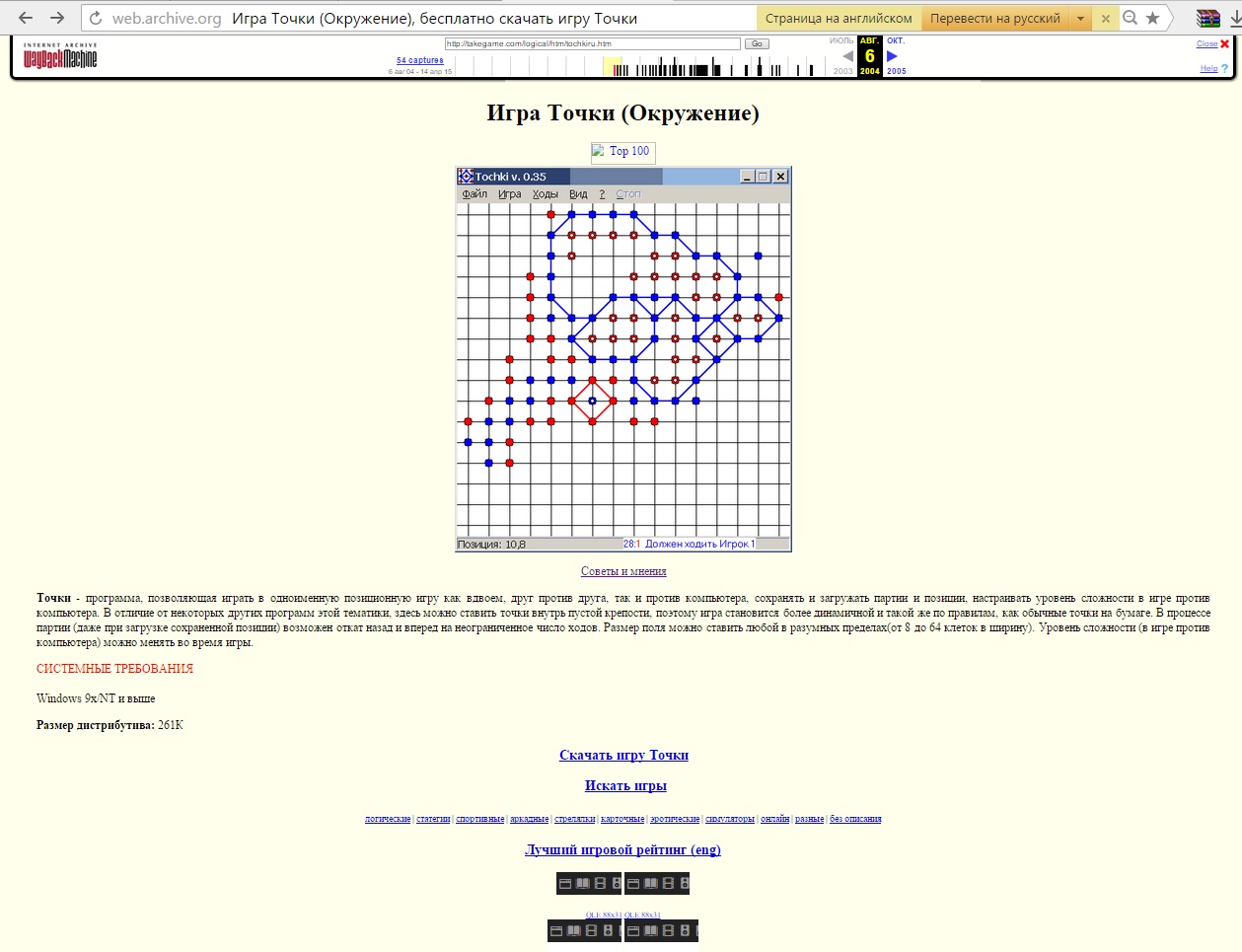
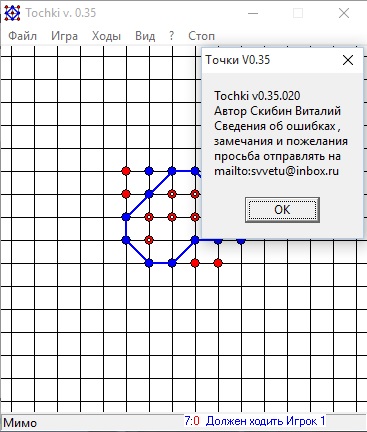
First, there's Tochki by Vitaly Skibin, a description page for which was first saved by the web archive on August 6, 2004. Overall, it's a unique take on the past: a simple client installed on a computer, allowing players to play locally against another player or against the AI. It differs from its predecessors in its richer functionality: saving and loading games, backtracking, and adjusting the board size over a wide range of values. As for the rules, the encirclement follows a minimal trajectory, houses are not painted over, there is no time limit per move, and there is no landing. The project's audience is unknown, and it has not been further developed.
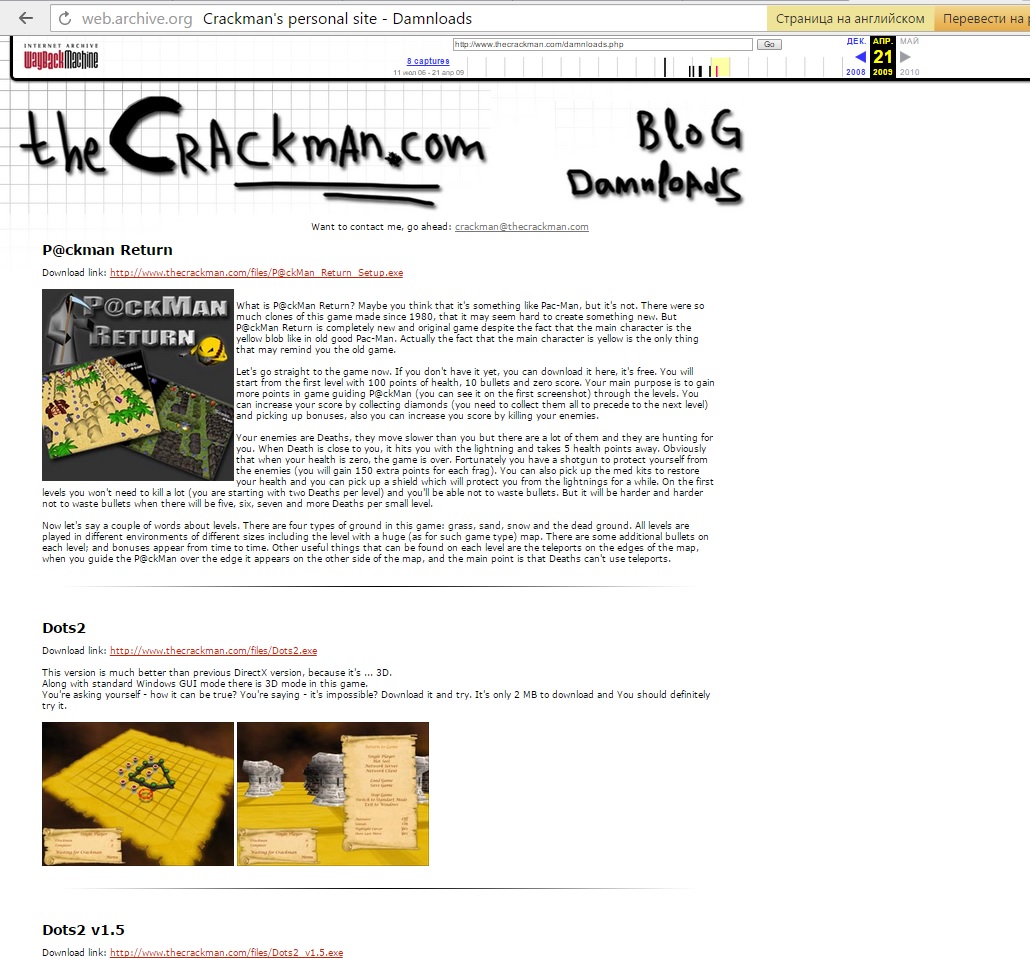
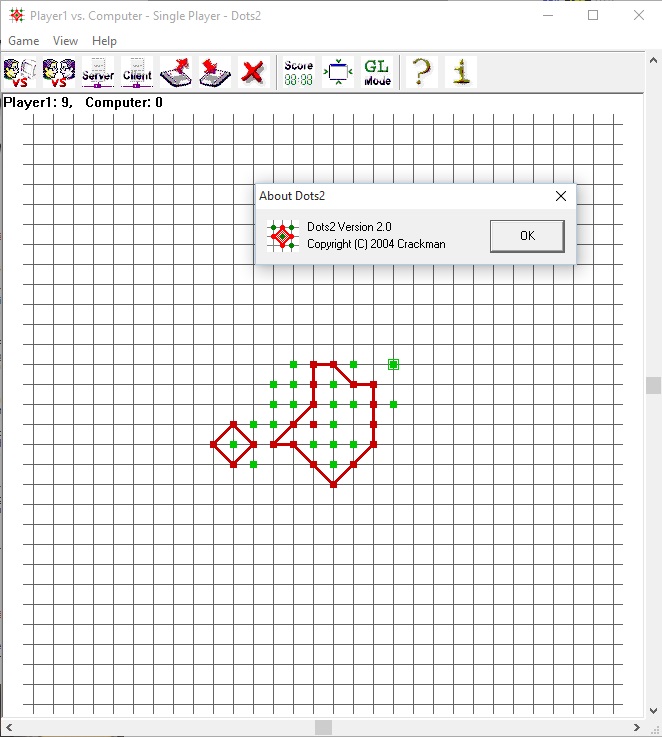
Secondly, Dots2 by Crackman is perhaps the most unusual client for the game Dots. Developed in 2004, apparently in the USA (this is an isolated example, so we'll consider it among other domestic projects), it's a computer-installable program with limited free functionality. Its main feature is the 3D game board, where dots are displayed as stone towers, and surrounding chains are represented by walls. You can also play on a standard flat board with red and green square dots. The client supports playing against yourself, against another player remotely, and against artificial intelligence. Dots2 allows you to save and load games, change the board size and cell scale, and turn on and off the move sound. There's no time limit per game, and there's no landing. Encirclement follows the maximum trajectory, but houses are not painted over. There's no information about its audience, but the program was quite well known in the post-Soviet gaming community. In terms of design, interface and marketing, it was one of the most advanced projects of the first period of development of computer Dots, which, in principle, is not surprising, given the country of origin.

So, let's summarize. At this stage, all clients were programs that needed to be downloaded and installed on a computer. This approach was consistent with the state of technology at the time and the skill level of the authors. The amateur status of most projects is obvious: almost all clients were free and distributed from primitive, crude, and uninformative websites. Advertising, feedback, and technical support were nonexistent. Most programs existed in one or two versions, but sometimes the authors' enthusiasm led to several updates. As for the rules of the game, at first they were pure carbon copies of the familiar "paper" version, but the first steps toward modern standards are still noticeable. The audience for these projects was tiny, and they left no significant mark on the history of Dots (except, perhaps, Torgashov's program and Dots2 by Crackman), but they did pave the way for their first real success.
Alexander Parfenov
First published October 29, 2015
Part One | Part three | Part Four | Part five